By using the data in Appendix E, determine whether each of the following substances is likely to serve as an oxidant or a reductant: (a) Cl2(g), (b) MnO4- (aq, acidic solution), (c) Ba(s)
Ch.20 - Electrochemistry

20장, 문제 49d
By using the data in Appendix E, determine whether each of the following substances is likely to serve as an oxidant or a reductant: (d) Zn(s)
검증된 단계별 안내1
Identify the standard reduction potential for the half-reaction involving Zn(s) from Appendix E.
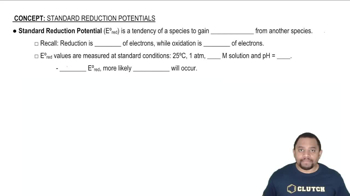
Recall that a substance with a more positive standard reduction potential is more likely to be reduced and act as an oxidant.
Conversely, a substance with a more negative standard reduction potential is more likely to be oxidized and act as a reductant.
Compare the standard reduction potential of Zn(s) with other substances to determine its tendency to act as an oxidant or reductant.
Conclude whether Zn(s) is more likely to serve as an oxidant or a reductant based on its standard reduction potential.

비슷한 문제에 대한 검증된 영상 답변:
이 영상 해법은 위 문제에 도움이 된다고 튜터들이 추천한 것입니다.
영상 길이:
2m도움이 되었나요?
주요 개념
질문에 올바르게 답하기 위해 반드시 이해해야 하는 핵심 개념들은 다음과 같습니다.
Oxidation and Reduction
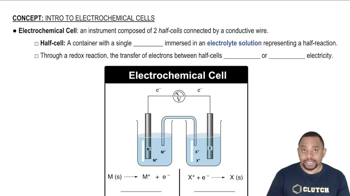
Oxidation and reduction are chemical processes that involve the transfer of electrons between substances. Oxidation refers to the loss of electrons, while reduction involves the gain of electrons. In redox reactions, one substance is oxidized and another is reduced, which is essential for understanding the roles of oxidants and reductants.
추천 영상:
가이드 코스
Oxidation and Reduction Reactions
Standard Reduction Potentials
Standard reduction potentials are values that indicate the tendency of a chemical species to be reduced, measured under standard conditions. These potentials are used to predict the direction of redox reactions and determine whether a substance will act as an oxidant or reductant. A higher reduction potential means a greater likelihood of being reduced.
추천 영상:
가이드 코스
Standard Reduction Potentials
Electrochemical Series
The electrochemical series is a list of standard reduction potentials for various half-reactions, arranged from highest to lowest. This series helps in identifying which substances can act as oxidants or reductants in a reaction. By comparing the position of a substance like Zn(s) in this series, one can infer its behavior in redox reactions.
추천 영상:
가이드 코스
Electrochemical Cells
관련 실천
교과서 질문
567
views
교과서 질문
From each of the following pairs of substances, use data in Appendix E to choose the one that is the stronger reducing agent: (a) Fe(s) or Mg(s) (b) Ca(s) or Al(s) (c) H2(g, acidic solution) or H2S(g)
341
views
교과서 질문
(a) Assuming standard conditions, arrange the following in order of increasing strength as oxidizing agents in acidic solution: Cr2O72-, H2O2, Cu2+, Cl2, O2.
688
views
교과서 질문
Is each of the following substances likely to serve as an oxidant or a reductant: (a) Ce3+(aq) (b) Ca(s) (c) ClO3-(aq) (d) N2O5(g)?
350
views
교과서 질문
(b) Arrange the following in order of increasing strength as reducing agents in acidic solution: Zn, I-, Sn2+, H2O2, Al.