
Ch.20 - Electrochemistry
Brown - Chemistry: The Central Science 15th Edition
Brown15th EditionChemistry: The Central ScienceISBN: 9780137542970당신이 사용하는 게 아니라요?교과서 변경
20장, 문제 79b

Heart pacemakers are often powered by lithium–silver chromate 'button' batteries. The overall cell reaction is 2 Li(s) + Ag2CrO4(s) → Li2CrO4(s) + 2 Ag(s) (b) Choose the two half-reactions from Appendix E that most closely approximate the reactions that occur in the battery. What standard emf would be generated by a voltaic cell based on these half-reactions?

검증된 단계별 안내
1
Step 1: Identify the oxidation and reduction half-reactions.
Step 2: Look up the standard reduction potentials for each half-reaction from Appendix E.
Step 3: Write the oxidation half-reaction and its corresponding standard potential.
Step 4: Write the reduction half-reaction and its corresponding standard potential.
Step 5: Calculate the standard emf (E°cell) by subtracting the standard potential of the oxidation half-reaction from the standard potential of the reduction half-reaction.

비슷한 문제에 대한 검증된 영상 답변:

이 영상 해법은 위 문제에 도움이 된다고 튜터들이 추천한 것입니다.
영상 길이:
7m
도움이 되었나요?

주요 개념

질문에 올바르게 답하기 위해 반드시 이해해야 하는 핵심 개념들은 다음과 같습니다.

Half-Reactions

Half-reactions represent the individual oxidation and reduction processes occurring in an electrochemical cell. In a voltaic cell, one half-reaction involves the loss of electrons (oxidation), while the other involves the gain of electrons (reduction). Understanding these half-reactions is crucial for determining the overall cell reaction and calculating the standard electromotive force (emf).
추천 영상:
가이드 코스
01:49
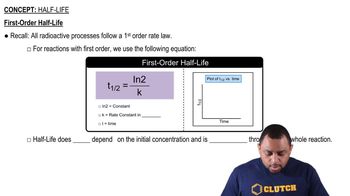
First-Order Half-Life

Standard Electrode Potential

The standard electrode potential (E°) is a measure of the tendency of a chemical species to be reduced, measured under standard conditions. Each half-reaction has a specific E° value, which can be found in electrochemical series tables. The standard emf of a voltaic cell can be calculated by subtracting the E° of the oxidation half-reaction from that of the reduction half-reaction.
추천 영상:
가이드 코스
01:27
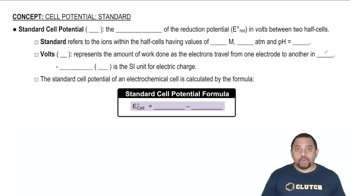
Standard Cell Potential

Voltaic Cell

A voltaic cell, also known as a galvanic cell, converts chemical energy into electrical energy through spontaneous redox reactions. It consists of two electrodes (anode and cathode) immersed in electrolyte solutions. The flow of electrons from the anode to the cathode generates an electric current, and the cell's emf indicates its voltage output, which is essential for applications like powering pacemakers.
추천 영상:
가이드 코스
01:21
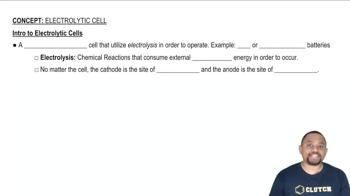
The Electrolytic Cell
관련 실천
교과서 질문

In some applications nickel–cadmium batteries have been replaced by nickel–zinc batteries. The overall cell reaction for this relatively new battery is: 2 H2O(l) + 2 NiO(OH)(s) + Zn(s) → 2 Ni(OH)2(s) + Zn(OH)2(s) (c) A single nickel–cadmium cell has a voltage of 1.30 V. Based on the difference in the standard reduction potentials of Cd2+ and Zn2+, what voltage would you estimate a nickel–zinc battery will produce? (d) Would you expect the specific energy density of a nickel–zinc battery to be higher or lower than that of a nickel–cadmium battery?

597
views
교과서 질문

During a period of discharge of a lead–acid battery, 402 g of Pb from the anode is converted into PbSO4(s). (b) How many coulombs of electrical charge are transferred from Pb to PbO2?

1
views
교과서 질문

During the discharge of an alkaline battery, 4.50 g of Zn is consumed at the anode of the battery. (b) How many coulombs of electrical charge are transferred from Zn to MnO2?

778
views
1
rank
교과서 질문

In some applications nickel–cadmium batteries have been replaced by nickel–zinc batteries. The overall cell reaction for this relatively new battery is: 2 H2O(l) + 2 NiO(OH)(s) + Zn(s) → 2 Ni(OH)2(s) + Zn(OH)2(s) (b) What is the anode half-reaction?

622
views
교과서 질문

Li-ion batteries used in automobiles typically use a LiMn2O4 cathode in place of the LiCoO2 cathode found in most Li-ion batteries. (a) Calculate the mass percent lithium in each electrode material.

713
views
교과서 질문

Heart pacemakers are often powered by lithium–silver chromate 'button' batteries. The overall cell reaction is 2 Li(s) + Ag2CrO4(s) → Li2CrO4(s) + 2 Ag(s) (a) Lithium metal is the reactant at one of the electrodes of the battery. Is it the anode or the cathode?

438
views