
Ch.21 - Nuclear Chemistry
Brown - Chemistry: The Central Science 15th Edition
Brown15th EditionChemistry: The Central ScienceISBN: 9780137542970당신이 사용하는 게 아니라요?교과서 변경
21장, 문제 74a

Chlorine has two stable nuclides, 35Cl and 37Cl. In contrast, 36Cl is a radioactive nuclide that decays by beta emission. (a) What is the product of decay of 36Cl?

검증된 단계별 안내
1
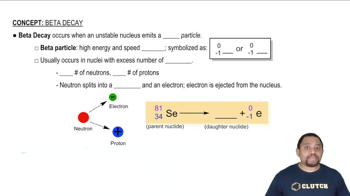
Identify the type of decay: 36Cl undergoes beta decay, which involves the conversion of a neutron into a proton, emitting a beta particle (an electron) and an antineutrino.
Write the nuclear equation for beta decay: In beta decay, the atomic number increases by 1 while the mass number remains unchanged.
Determine the new element: Since the atomic number increases by 1, the element changes from chlorine (Cl) to the next element in the periodic table, which is argon (Ar).
Write the balanced nuclear equation: \( ^{36}_{17}\text{Cl} \rightarrow ^{36}_{18}\text{Ar} + \beta^- + \bar{\nu}_e \), where \( \beta^- \) is the beta particle and \( \bar{\nu}_e \) is the antineutrino.
Conclude the product: The product of the beta decay of 36Cl is 36Ar.

비슷한 문제에 대한 검증된 영상 답변:

이 영상 해법은 위 문제에 도움이 된다고 튜터들이 추천한 것입니다.
영상 길이:
2m

주요 개념

질문에 올바르게 답하기 위해 반드시 이해해야 하는 핵심 개념들은 다음과 같습니다.

Beta Decay

Beta decay is a type of radioactive decay in which a beta particle (an electron or a positron) is emitted from an atomic nucleus. In the case of beta minus decay, a neutron is transformed into a proton, resulting in the emission of an electron and an antineutrino. This process increases the atomic number of the element by one, leading to the formation of a new element.
추천 영상:

Nuclear Stability

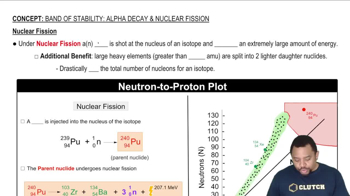
Nuclear stability refers to the ability of an atomic nucleus to remain intact without undergoing radioactive decay. Stable nuclides, like 35Cl and 37Cl, have a balanced ratio of protons to neutrons, while unstable nuclides, such as 36Cl, have an imbalance that leads to decay. Understanding the factors that contribute to nuclear stability is essential for predicting the behavior of different isotopes.
추천 영상:
가이드 코스
03:29
Band of Stability: Nuclear Fission

Decay Products

Decay products are the new elements or isotopes formed as a result of radioactive decay. In the case of 36Cl undergoing beta decay, the decay product is 37Ar (argon), as the emission of a beta particle transforms the chlorine nucleus into an argon nucleus. Identifying decay products is crucial for understanding the implications of radioactive decay in various applications, including nuclear medicine and radiometric dating.
추천 영상:
관련 실천
교과서 질문

Chlorine has two stable nuclides, 35Cl and 37Cl. In contrast, 36Cl is a radioactive nuclide that decays by beta emission. (b) Based on the empirical rules about nuclear stability, explain why the nucleus of 36Cl is less stable than either 35Cl or 37Cl.

교과서 질문

The table provided gives the number of protons (p) and neutrons (n) for four isotopes, identified only as (i)–(iv). a. Write the symbol for each of the isotopes.

교과서 질문

Radon-222 decays to a stable nucleus by a series of three alpha emissions and two beta emissions. What is the stable nucleus that is formed?

1435
views
교과서 질문

Nuclear scientists have synthesized approximately 1600 nuclei not known in nature. More might be discovered with heavy-ion bombardment using high-energy particle accelerators. Complete and balance the following reactions, which involve heavy-ion bombardments:

(a) 63Li + 5628Ni → ?

(b) 4020Ca + 24896Cm → 14762Sm + ?

(c) 8838Sr + 8436Kr → 11646Pd + ?

(d) 4020Ca + 23892U → 7030Zn + 4 10n + 2 ?

344
views
교과서 질문

In 2010, a team of scientists from Russia and the United States reported creation of the first atom of element 117, which is named tennessine, and whose symbol is Ts. The synthesis involved the collision of a target of 24997Bk with accelerated ions of an isotope which we will denote Q. The product atom, which we will call Z, immediately releases neutrons and forms 294117Ts: 24997Bk + Q → Z → 294117Ts + 3 10n (a) What are the identities of isotopes Q and Z? (c) Collision of ions of isotope Q with a target was also used to produce the first atoms of livermorium, Lv. The initial product of this collision was 296116Lv. What was the target isotope with which Q collided in this experiment?