
Ch.21 - Nuclear Chemistry
Brown - Chemistry: The Central Science 15th Edition
Brown15th EditionChemistry: The Central ScienceISBN: 9780137542970당신이 사용하는 게 아니라요?교과서 변경
21장, 문제 55b

Iodine-131 is a convenient radioisotope to monitor thyroid activity in humans. It is a beta emitter with a half-life of 8.02 days. The thyroid is the only gland in the body that uses iodine. A person undergoing a test of thyroid activity drinks a solution of NaI, in which only a small fraction of the iodide is radioactive. b. A normal thyroid will take up about 12% of the ingested iodide in a few hours. How long will it take for the radioactive iodide taken up and held by the thyroid to decay to 0.01% of the original amount?

검증된 단계별 안내
1
Identify the initial percentage of radioactive iodide taken up by the thyroid, which is 12% of the ingested amount.
Recognize that the problem involves radioactive decay, which follows first-order kinetics. Use the formula for first-order decay: \( N_t = N_0 e^{-kt} \), where \( N_t \) is the remaining amount, \( N_0 \) is the initial amount, \( k \) is the decay constant, and \( t \) is time.
Calculate the decay constant \( k \) using the half-life formula: \( k = \frac{\ln(2)}{\text{half-life}} \). Substitute the given half-life of 8.02 days into the formula.
Set up the equation to find the time \( t \) when the remaining radioactive iodide is 0.01% of the initial amount. Substitute \( N_t = 0.01\% \times N_0 \) into the decay equation.
Solve the equation \( 0.01\% \times N_0 = N_0 e^{-kt} \) for \( t \) by taking the natural logarithm of both sides and isolating \( t \).

비슷한 문제에 대한 검증된 영상 답변:

이 영상 해법은 위 문제에 도움이 된다고 튜터들이 추천한 것입니다.
영상 길이:
5m

주요 개념

질문에 올바르게 답하기 위해 반드시 이해해야 하는 핵심 개념들은 다음과 같습니다.

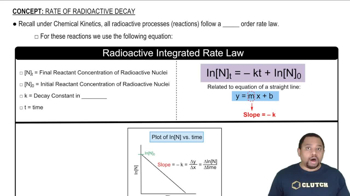
Radioactive Decay

Radioactive decay is the process by which an unstable atomic nucleus loses energy by emitting radiation. This decay occurs at a predictable rate characterized by the half-life, which is the time required for half of the radioactive substance to decay. Understanding this concept is crucial for calculating how long it takes for a given amount of a radioactive isotope, like iodine-131, to reduce to a specific fraction of its original quantity.
추천 영상:
가이드 코스
03:00
Rate of Radioactive Decay

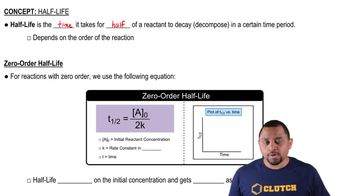
Half-Life

Half-life is a fundamental concept in nuclear chemistry that describes the time it takes for half of a sample of a radioactive substance to decay. For iodine-131, the half-life is 8.02 days, meaning that after this period, only half of the original amount remains. This concept is essential for determining the time required for the radioactive iodide in the thyroid to decay to a specified percentage of its initial amount.
추천 영상:
가이드 코스
02:17
Zero-Order Half-life

Exponential Decay

Exponential decay refers to the decrease of a quantity at a rate proportional to its current value, commonly observed in radioactive substances. The amount of radioactive material remaining can be modeled using the equation N(t) = N0 * (1/2)^(t/T), where N0 is the initial amount, T is the half-life, and t is the elapsed time. This concept is vital for solving problems related to the decay of radioactive isotopes over time.
추천 영상: