Ch.21 - Nuclear Chemistry
Brown - Chemistry: The Central Science 15th Edition
Brown15th EditionChemistry: The Central ScienceISBN: 9780137542970당신이 사용하는 게 아니라요?교과서 변경
21장, 문제 17

The naturally occurring radioactive decay series that begins with 235 92U stops with the formation of the stable 207 82Pb nucleus. The decays proceed through a series of alpha-particle and beta-particle emissions. How many of each type of emission are involved in this series?

검증된 단계별 안내
1
Step 1: Understand the problem by identifying the starting and ending isotopes in the decay series. The series starts with uranium-235 (\(^{235}_{92}\text{U}\)) and ends with lead-207 (\(^{207}_{82}\text{Pb}\)).
Step 2: Determine the change in atomic number and mass number. The atomic number changes from 92 to 82, and the mass number changes from 235 to 207.
Step 3: Recall that an alpha particle emission decreases the atomic number by 2 and the mass number by 4. A beta particle emission increases the atomic number by 1 without changing the mass number.
Step 4: Calculate the total change in atomic number (92 to 82) and mass number (235 to 207) to determine the number of alpha and beta emissions. Use the equations: \(\Delta Z = -2n + m\) and \(\Delta A = -4n\), where \(n\) is the number of alpha emissions and \(m\) is the number of beta emissions.
Step 5: Solve the system of equations from Step 4 to find the values of \(n\) and \(m\), representing the number of alpha and beta emissions, respectively.

주요 개념

질문에 올바르게 답하기 위해 반드시 이해해야 하는 핵심 개념들은 다음과 같습니다.

Radioactive Decay

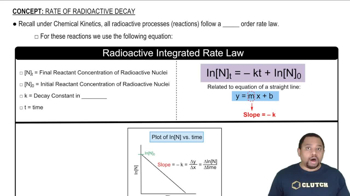
Radioactive decay is the process by which unstable atomic nuclei lose energy by emitting radiation. This can occur in various forms, including alpha and beta decay. In alpha decay, an atomic nucleus emits an alpha particle (two protons and two neutrons), while in beta decay, a neutron is transformed into a proton, emitting a beta particle (an electron or positron). Understanding these processes is crucial for analyzing decay series.
추천 영상:
가이드 코스
03:00
Rate of Radioactive Decay

Decay Series

A decay series is a sequence of radioactive decays that an unstable nucleus undergoes until it reaches a stable end product. Each step in the series involves the transformation of one element into another, often through multiple alpha and beta emissions. In the case of uranium-235 decaying to lead-207, the series includes several intermediate isotopes, each with its own decay path.
추천 영상:
가이드 코스
02:02
Activity Series Chart

Alpha and Beta Emissions

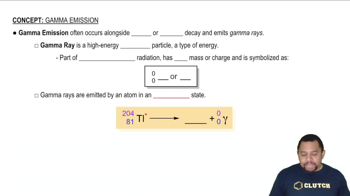
Alpha and beta emissions are two primary types of radioactive decay. Alpha emissions reduce the atomic number by two and the mass number by four, while beta emissions increase the atomic number by one without changing the mass number. The balance of these emissions in a decay series determines the number of steps and the types of isotopes produced before reaching a stable nucleus, such as lead-207.
추천 영상: