Ch.3 - Chemical Reactions and Reaction Stoichiometry
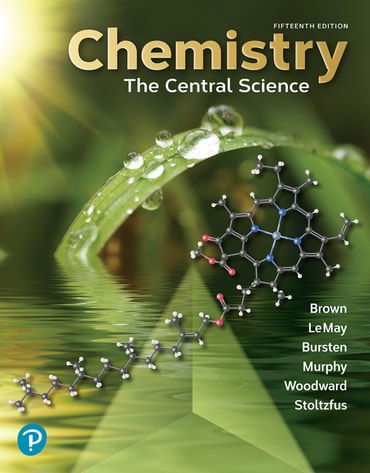
Brown - Chemistry: The Central Science 15th Edition
Brown15th EditionChemistry: The Central ScienceISBN: 9780137542970당신이 사용하는 게 아니라요?교과서 변경
3장, 문제 5a

Glycine, an amino acid used by organisms to make proteins, is represented by the following molecular model. (a) Write its molecular formula.

검증된 단계별 안내
1
Step 1: Identify the different types of atoms in the molecule. In glycine, you will find carbon (C), hydrogen (H), nitrogen (N), and oxygen (O) atoms.
Step 2: Count the number of each type of atom in the molecule. For glycine, you will find 2 carbon atoms, 5 hydrogen atoms, 1 nitrogen atom, and 2 oxygen atoms.
Step 3: Write the molecular formula by listing the types of atoms followed by the number of each type of atom in subscript. If there is only one atom of a certain type, you do not need to write '1'.
Step 4: Following the above steps, the molecular formula for glycine is C2H5NO2.

비슷한 문제에 대한 검증된 영상 답변:

이 영상 해법은 위 문제에 도움이 된다고 튜터들이 추천한 것입니다.
영상 길이:
2m

주요 개념

질문에 올바르게 답하기 위해 반드시 이해해야 하는 핵심 개념들은 다음과 같습니다.

Amino Acids

Amino acids are organic compounds that serve as the building blocks of proteins. Each amino acid contains a central carbon atom, an amino group (-NH2), a carboxyl group (-COOH), a hydrogen atom, and a variable side chain (R group) that determines the specific properties of the amino acid. Glycine is the simplest amino acid, with a hydrogen atom as its side chain.
추천 영상:

Molecular Formula

A molecular formula represents the number and types of atoms in a molecule. It is expressed using chemical symbols and subscripts to indicate the quantity of each type of atom. For glycine, the molecular formula is derived from its structure, which includes two carbon atoms, five hydrogen atoms, one nitrogen atom, and two oxygen atoms.
추천 영상:
가이드 코스
02:08
Determining Molecular Formulas

Chemical Structure of Glycine

The chemical structure of glycine can be depicted as NH2-CH2-COOH, indicating its functional groups. The amino group (NH2) and carboxyl group (COOH) are essential for its classification as an amino acid. Understanding this structure is crucial for writing the correct molecular formula, which reflects the composition of the molecule.
추천 영상:
가이드 코스
03:31
Chemical Properties
관련 실천
교과서 질문

The following diagram shows the combination reaction between hydrogen, H2, and carbon monoxide, CO, to produce methanol, CH3OH (white spheres are H, black spheres are C, red spheres are O). The correct number of CO molecules involved in this reaction is not shown. (b) Write a balanced chemical equation for the reaction.

457
views
교과서 질문

The following diagram represents a high-temperature reaction between CH4 and H2O. Based on this reaction, find how many moles of each product can be obtained starting with 4.0 mol CH4.

Based on this reaction, find how many moles of CO can be obtained starting with 4.0 mol CH4?

904
views
1
rank
교과서 질문

The following diagram represents the collection of CO2 and H2O molecules formed by complete combustion of a hydrocarbon. What is the empirical formula of the hydrocarbon?

818
views
1
rank
교과서 질문

Glycine, an amino acid used by organisms to make proteins, is represented by the following molecular model. (c) Calculate how many moles of glycine are in a 100.0-g sample of glycine.

580
views
교과서 질문

Glycine, an amino acid used by organisms to make proteins, is represented by the following molecular model. (d) Calculate the percent nitrogen by mass in glycine.

832
views
교과서 질문

The following diagram represents the collection of elements formed by a decomposition reaction. (a) If the blue spheres represent N atoms and the red ones represent O atoms, what was the empirical formula of the original compound?

741
views
1
rank