
Ch.4 - Reactions in Aqueous Solution
Brown - Chemistry: The Central Science 15th Edition
Brown15th EditionChemistry: The Central ScienceISBN: 9780137542970당신이 사용하는 게 아니라요?교과서 변경
4장, 문제 88c

A solution is made by mixing 15.0 g of Sr(OH)2 and 55.0 mL of 0.200 M HNO3. c. Is the resulting solution acidic or basic?

검증된 단계별 안내
1
Calculate the moles of Sr(OH)_2 using its molar mass.
Calculate the moles of HNO_3 using its molarity and volume.
Write the balanced chemical equation for the reaction: Sr(OH)_2 + 2HNO_3 -> Sr(NO_3)_2 + 2H_2O.
Determine the limiting reactant by comparing the mole ratio from the balanced equation.
Determine if there is an excess of HNO_3 or Sr(OH)_2 to decide if the solution is acidic or basic.

비슷한 문제에 대한 검증된 영상 답변:

이 영상 해법은 위 문제에 도움이 된다고 튜터들이 추천한 것입니다.
영상 길이:
3m

주요 개념

질문에 올바르게 답하기 위해 반드시 이해해야 하는 핵심 개념들은 다음과 같습니다.

Acid-Base Reactions

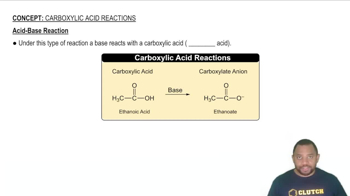
Acid-base reactions involve the transfer of protons (H⁺ ions) between reactants. In this case, HNO3 is a strong acid that dissociates completely in solution, while Sr(OH)2 is a strong base that also dissociates completely. The reaction between them will determine the resulting pH of the solution, indicating whether it is acidic or basic.
추천 영상:
가이드 코스
01:09
Acid-Base Reaction

Stoichiometry

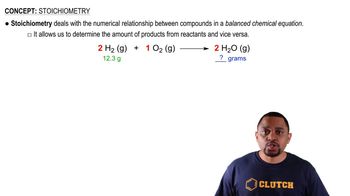
Stoichiometry is the calculation of reactants and products in chemical reactions. To determine if the solution is acidic or basic, one must calculate the moles of HNO3 and Sr(OH)2 present. This involves converting grams of Sr(OH)2 to moles and comparing the mole ratio of acid to base to see which is in excess.
추천 영상:
가이드 코스
01:16
Stoichiometry Concept

pH Scale

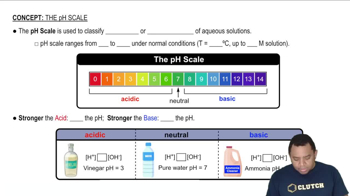
The pH scale measures the acidity or basicity of a solution, ranging from 0 (very acidic) to 14 (very basic), with 7 being neutral. After determining the amounts of acid and base, the resulting pH can be calculated. A pH less than 7 indicates an acidic solution, while a pH greater than 7 indicates a basic solution.
추천 영상: