


Ch.4 - Reactions in Aqueous Solution
Brown - Chemistry: The Central Science 15th Edition
Brown15th EditionChemistry: The Central ScienceISBN: 9780137542970당신이 사용하는 게 아니라요?교과서 변경
4장, 문제 98a

Hard water contains Ca2+, Mg2+, and Fe2+, which interfere with the action of soap and leave an insoluble coating on the insides of containers and pipes when heated. Water softeners replace these ions with Na+. Keep in mind that charge balance must be maintained. (a) If 1500 L of hard water contains 0.020 M Ca2+ and 0.0040 M Mg2+, how many moles of Na+ are needed to replace these ions?

검증된 단계별 안내
1
Calculate the moles of Ca^{2+} in the hard water by using the formula: \(\text{moles of }\) Ca^{2+} = \(\text{volume of water (L)}\) \(\times\) \(\text{molarity of }\) Ca^{2+}
Calculate the moles of Mg^{2+} in the hard water by using the formula: \(\text{moles of }\) Mg^{2+} = \(\text{volume of water (L)}\) \(\times\) \(\text{molarity of }\) Mg^{2+}
Determine the total moles of divalent cations (Ca^{2+} and Mg^{2+}) by adding the moles of Ca^{2+} and Mg^{2+}
Since each divalent cation (Ca^{2+} or Mg^{2+}) is replaced by two Na^+ ions to maintain charge balance, calculate the total moles of Na^+ needed by multiplying the total moles of divalent cations by 2
Summarize the calculation to find the total moles of Na^+ required to replace the Ca^{2+} and Mg^{2+} ions in the hard water

비슷한 문제에 대한 검증된 영상 답변:

이 영상 해법은 위 문제에 도움이 된다고 튜터들이 추천한 것입니다.
영상 길이:
1m
도움이 되었나요?

주요 개념

질문에 올바르게 답하기 위해 반드시 이해해야 하는 핵심 개념들은 다음과 같습니다.

Ion Concentration and Molarity

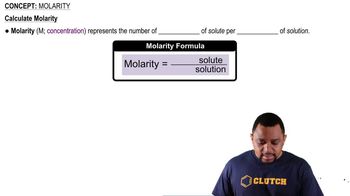
Molarity (M) is a measure of concentration defined as the number of moles of solute per liter of solution. In this context, the concentrations of Ca2+ and Mg2+ ions in hard water are given in molarity, which allows us to calculate the total number of moles present in a specific volume of water. Understanding molarity is essential for determining how many moles of Na+ are needed to replace these ions.
추천 영상:
가이드 코스
00:53
Molarity Concept

Charge Balance in Solutions

Charge balance refers to the principle that in a neutral solution, the total positive charge must equal the total negative charge. In the case of water softening, replacing Ca2+ and Mg2+ (both divalent cations) with Na+ (a monovalent cation) requires careful calculation to ensure that the overall charge remains balanced. This concept is crucial for understanding how to effectively soften water without altering its overall ionic balance.
추천 영상:
가이드 코스
01:04
Balancing Basic Redox Reactions

Stoichiometry in Chemical Reactions

Stoichiometry involves the calculation of reactants and products in chemical reactions based on balanced equations. In this scenario, stoichiometric principles are applied to determine the exact number of moles of Na+ needed to replace the moles of Ca2+ and Mg2+ in the hard water. This concept is fundamental for solving problems related to ion exchange and ensuring that the correct amounts of substances are used.
추천 영상:
가이드 코스
01:16
Stoichiometry Concept
관련 실천
교과서 질문

The commercial production of nitric acid involves the following chemical reactions:

4 NH3(g) + 5 O2(g) → 4 NO(g) + 6 H2O(g)

2 NO(g) + O2(g) → 2 NO2(g)

3 NO2(g) + H2O(l) → 2 HNO3(aq) + NO(g)

(c) How many grams of ammonia must you start with to make 1000.0 L of a 0.150 M aqueous solution of nitric acid? Assume all the reactions give 100% yield.

1255
views
교과서 질문

Hard water contains Ca2+, Mg2+, and Fe2+, which interfere with the action of soap and leave an insoluble coating on the insides of containers and pipes when heated. Water softeners replace these ions with Na+. Keep in mind that charge balance must be maintained. (b) If the sodium is added to the water softener in the form of NaCl, how many grams of sodium chloride are needed?

843
views
교과서 질문

Neurotransmitters are molecules that are released by nerve cells to other cells in our bodies, and are needed for muscle motion, thinking, feeling, and memory. Dopamine is a common neurotransmitter in the human brain and is a weak base. Its molecular weight is 153.2 g/mol. b. Experiments with rats show that if rats are dosed with 3.0 mg/kg of cocaine (that is, 3.0 mg cocaine per kg of animal mass), the concentration of dopamine in their brains increases by 0.75 𝜇𝑀 after 60 seconds. Calculate how many molecules of dopamine would be produced in a rat (average brain volume 5.00mm3) after 60 seconds of a 3.0 mg/kg dose of cocaine.


2
views
교과서 질문

Tartaric acid, H2C4H4O6, has two acidic hydrogens. The acid is often present in wines, and a salt derived from the acid precipitates from solution as the wine ages. A solution containing an unknown concentration of the acid is titrated with NaOH. It requires 24.65 mL of 0.2500 M NaOH solution to titrate both acidic protons in 50.00 mL of the tartaric acid solution. Write a balanced net ionic equation for the neutralization reaction

2
views
교과서 질문

The commercial production of nitric acid involves the following chemical reactions:

4 NH3(g) + 5 O2(g) → 4 NO(g) + 6 H2O(g)

2 NO(g) + O2(g) → 2 NO2(g)

3 NO2(g) + H2O(l) → 2 HNO3(aq) + NO(g)

(b) Identify the element undergoing oxidation and the element undergoing reduction.

365
views
교과서 질문

Tartaric acid, H2C4H4O6, has two acidic hydrogens. The acid is often present in wines, and a salt derived from the acid precipitates from solution as the wine ages. A solution containing an unknown concentration of the acid is titrated with NaOH. It requires 24.65 mL of 0.2500 M NaOH solution to titrate both acidic protons in 50.00 mL of the tartaric acid solution. Calculate the molarity of the tartaric acid solution.

2
views