
State whether each of the following statements is true or false. Justify your answer in each case. (b) If you add a nonelectrolyte to an aqueous solution that already contains an electrolyte, the electrical conductivity will not change.
Ch.4 - Reactions in Aqueous Solution

4장, 문제 12
In a titration experiment, 50.0 mL of 0.075 M acetic acid, CH3COOH, is titrated with the 0.250 M KOH(aq) that is in the burette. The drawing shows the level of the KOH in the burette before the titration begins. What will be the burette reading at the equivalence point?
검증된 단계별 안내1
Identify the balanced chemical equation for the reaction: CH_3COOH + KOH \(\rightarrow\) CH_3COOK + H_2O.
Calculate the moles of acetic acid (CH_3COOH) present using the formula: \(\text{moles}\) = \(\text{concentration}\) \(\times\) \(\text{volume}\).
Since the reaction is a 1:1 molar ratio, the moles of KOH required will be equal to the moles of acetic acid calculated.
Determine the volume of KOH needed using the formula: \(\text{volume}\) = \(\frac{\text{moles of KOH}\)}{\(\text{concentration of KOH}\)}.
Add the calculated volume of KOH to the initial burette reading to find the burette reading at the equivalence point.

비슷한 문제에 대한 검증된 영상 답변:
이 영상 해법은 위 문제에 도움이 된다고 튜터들이 추천한 것입니다.
영상 길이:
7m주요 개념
질문에 올바르게 답하기 위해 반드시 이해해야 하는 핵심 개념들은 다음과 같습니다.
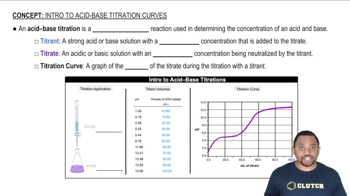
Titration
Titration is a quantitative analytical technique used to determine the concentration of a solute in a solution. It involves the gradual addition of a titrant (a solution of known concentration) to a sample solution until the reaction reaches its equivalence point, where the amount of titrant added is stoichiometrically equivalent to the amount of substance in the sample.
추천 영상:
가이드 코스
Acid-Base Titration
Equivalence Point
The equivalence point in a titration is the stage at which the amount of titrant added is exactly enough to completely neutralize the analyte solution. At this point, the moles of acid equal the moles of base, and it is often indicated by a color change in an indicator or by measuring pH. Understanding this concept is crucial for calculating the final burette reading.
추천 영상:
가이드 코스
At the Equivalence Point
Molarity and Volume Calculations
Molarity (M) is a measure of concentration defined as moles of solute per liter of solution. In titration calculations, the relationship between the molarity and volume of the acid and base solutions is used to determine the volume of titrant needed to reach the equivalence point. The formula M1V1 = M2V2 helps in calculating the required volumes based on their respective molarities.
추천 영상:
가이드 코스
Molar Mass Calculation Example
관련 실천
교과서 질문
987
views
교과서 질문
An aqueous solution contains 1.2 mM of total ions. (a) If the solution is NaCl(aq), what is the concentration of chloride ion?
1143
views
교과서 질문
What kind of reaction is this? N2(g)+3H2(g)⟶2NH3(g)
a. an acid–base reaction
b. a metathesis reaction
c. a redox reaction
d. a precipitation reaction
3
views
교과서 질문
State whether each of the following statements is true or false. Justify your answer in each case. (a) Electrolyte solutions conduct electricity because electrons are moving through the solution.
517
views
교과서 질문
An aqueous solution contains 1.2 mM of total ions. (b) If the solution is FeCl3(aq), what is the concentration of chloride ion?
532
views
