Ch.4 - Reactions in Aqueous Solution
Brown - Chemistry: The Central Science 15th Edition
Brown15th EditionChemistry: The Central ScienceISBN: 9780137542970당신이 사용하는 게 아니라요?교과서 변경
4장, 문제 27

Separate samples of a solution of an unknown salt are treated with dilute solutions of HBr, H2SO4, and NaOH. A precipitate forms in all three cases. Which of the following cations could be present in the unknown salt solution: K+, Pb2+, Ba2+?

검증된 단계별 안내
1
Identify the possible reactions that could occur when the unknown salt solution is treated with HBr, H2SO4, and NaOH.
Consider the solubility rules for common ionic compounds to determine which cations form precipitates with the given anions.
For HBr, check which cations form insoluble bromides. Pb^{2+} forms PbBr2, which is insoluble.
For H2SO4, check which cations form insoluble sulfates. Ba^{2+} forms BaSO4, which is insoluble.
For NaOH, check which cations form insoluble hydroxides. Pb^{2+} forms Pb(OH)2, which is insoluble.

주요 개념

질문에 올바르게 답하기 위해 반드시 이해해야 하는 핵심 개념들은 다음과 같습니다.

Precipitation Reactions

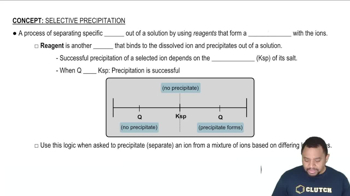
Precipitation reactions occur when two soluble salts react in solution to form an insoluble compound, known as a precipitate. The formation of a precipitate indicates that the ions in solution have combined to form a compound that is not soluble in water. Understanding the solubility rules helps predict whether a precipitate will form when different reagents are added to a solution.
추천 영상:
가이드 코스
01:53
Selective Precipitation

Acid-Base Reactions

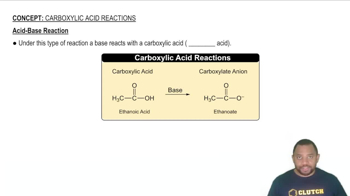
Acid-base reactions involve the transfer of protons (H+) between reactants. In this context, HBr and H2SO4 are strong acids that can react with bases or certain metal cations to form soluble or insoluble salts. The ability of a cation to form a precipitate with an acid indicates its reactivity and solubility characteristics, which are essential for identifying the unknown salt.
추천 영상:
가이드 코스
01:09
Acid-Base Reaction

Solubility Rules

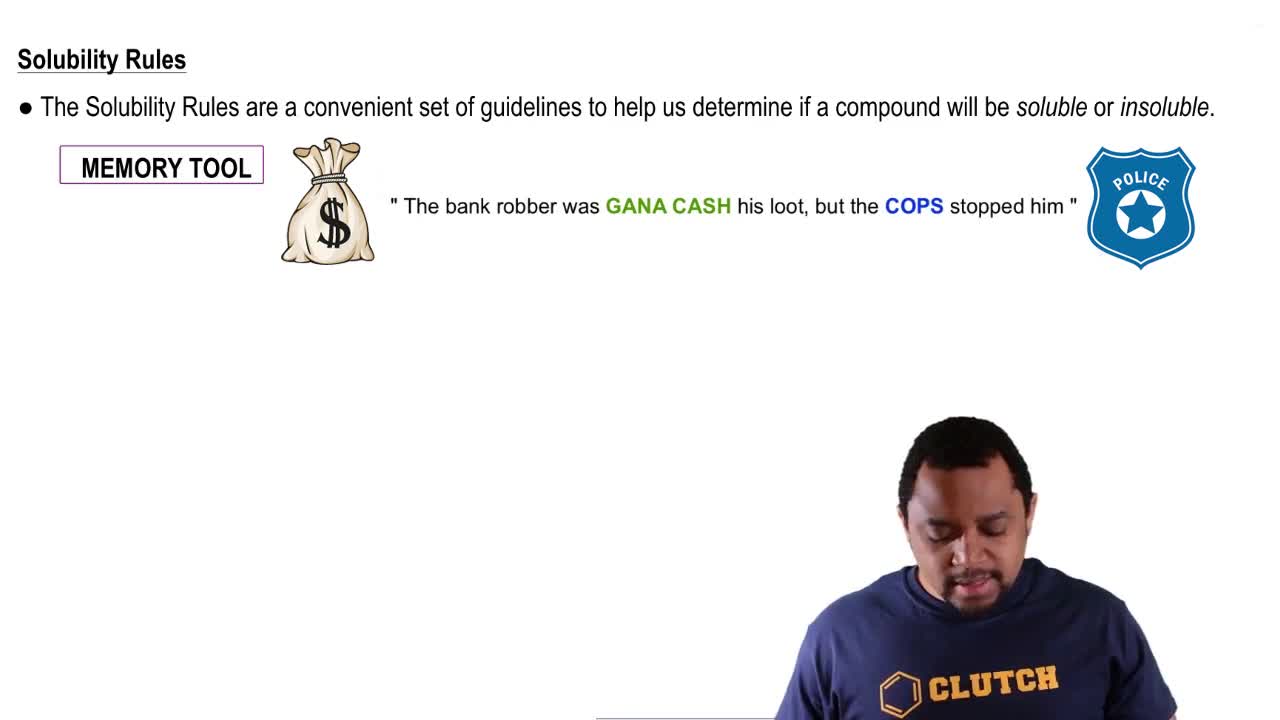
Solubility rules are guidelines that predict the solubility of various ionic compounds in water. For example, most sulfates are soluble, except for those of barium, lead, and calcium, while hydroxides are generally insoluble except for alkali metals and some alkaline earth metals. These rules are crucial for determining which cations (K+, Pb2+, Ba2+) could be present in the unknown salt based on the observed precipitate formation.
추천 영상:
가이드 코스
00:28
Solubility Rules
관련 실천
교과서 질문

Which ions remain in solution, unreacted, after each of the following pairs of solutions is mixed? (c) ammonium phosphate and calcium chloride

904
views

교과서 질문

Separate samples of a solution of an unknown ionic compound are treated with dilute AgNO3, Pb1NO322, and BaCl2. Precipitates form in all three cases. Which of the following could be the anion of the unknown salt: Br-, CO32-, NO3-?

1171
views
교과서 질문

Write balanced net ionic equations for the reactions that occur in each of the following cases. Identify the spectator ion or ions in each reaction. a. Cr2(SO4)3(𝑎𝑞)+(NH4)2CO3(𝑎𝑞)⟶

6
views
교과서 질문

Write balanced net ionic equations for the reactions that occur in each of the following cases. Identify the spectator ion or ions in each reaction. c. Fe(NO3)2(𝑎𝑞)+KOH(𝑎𝑞)⟶

2
views
교과서 질문

You know that an unlabeled bottle contains an aqueous solution of one of the following: AgNO3,CaCl2, or Al2(SO4)3. You take a portion of the solution and add an aqueous solution of Ba(NO3)2 to it, and observe that a white solid precipitates Then you take another portion of the unlabeled solution and add an aqueous solution of NaCl to it; nothing appears to happen. What is the most likely identity of the solution in the unlabeled bottle: silver nitrate, calcium chloride, aluminum sulfate?

3
views
교과서 질문

Three solutions are mixed together to form a single solution; in the final solution, there are 0.2 mol Pb1CH3COO)2, 0.1 mol Na2S, and 0.1 mol CaCl2 present. What solid(s) will precipitate?

2338
views
4
rank