
교과서 질문
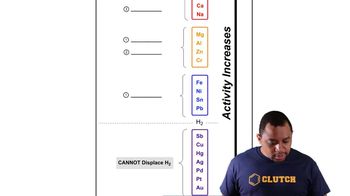
Using the activity series (Table 4.5), write balanced chemical equations for the following reactions. If no reaction occurs, write NR. (e) aluminum metal is added to a solution of cobalt(II) sulfate.
422
views

 검증된 단계별 안내
 02:02
02:02
 01:11
01:11 01:32
01:32Using the activity series (Table 4.5), write balanced chemical equations for the following reactions. If no reaction occurs, write NR. (e) aluminum metal is added to a solution of cobalt(II) sulfate.
Using the activity series (Table 4.5), write balanced chemical equations for the following reactions. If no reaction occurs, write NR. (d) chromium metal is immersed in an aqueous solution of cobalt(II) chloride
Using the activity series (Table 4.5), write balanced chemical equations for the following reactions. If no reaction occurs, write NR. (e) hydrogen gas is bubbled through a solution of silver nitrate.
Using the activity series (Table 4.5), write balanced chemical equations for the following reactions. If no reaction occurs, write NR. (d) hydrogen gas is bubbled through an aqueous solution of nickel(II) chloride
Using the activity series (Table 4.5), write balanced chemical equations for the following reactions. If no reaction occurs, write NR. (b) a solution of zinc nitrate is added to a solution of magnesium sulfate (c) hydrochloric acid is added to gold metal
Using the activity series (Table 4.5), write balanced chemical equations for the following reactions. If no reaction occurs, write NR. (c) hydrobromic acid is added to tin metal