Ch.5 - Thermochemistry
Brown - Chemistry: The Central Science 15th Edition
Brown15th EditionChemistry: The Central ScienceISBN: 9780137542970당신이 사용하는 게 아니라요?교과서 변경
5장, 문제 71b

For each of the following compounds, write a balanced thermochemical equation depicting the formation of one mole of the compound from its elements in their standard states and then look up H °f for each substance in Appendix C. (b) FeCl3(s)

검증된 단계별 안내
1
Identify the elements involved in the formation of FeCl_3(s): iron (Fe) and chlorine (Cl).
Determine the standard states of these elements: Fe is a solid (s) and Cl is a diatomic gas (Cl_2(g)).
Write the unbalanced chemical equation for the formation of FeCl_3(s) from its elements: Fe(s) + Cl_2(g) -> FeCl_3(s).
Balance the chemical equation: Since FeCl_3 contains three chlorine atoms, you need 3/2 Cl_2 molecules to provide three Cl atoms. The balanced equation is: Fe(s) + \(\frac{3}{2}\)Cl_2(g) -> FeCl_3(s).
Look up the standard enthalpy of formation (\(\Delta\) H^\(\circ\)_f) for FeCl_3(s) in Appendix C to complete the thermochemical equation.

비슷한 문제에 대한 검증된 영상 답변:

이 영상 해법은 위 문제에 도움이 된다고 튜터들이 추천한 것입니다.
영상 길이:
2m

주요 개념

질문에 올바르게 답하기 위해 반드시 이해해야 하는 핵심 개념들은 다음과 같습니다.

Thermochemical Equations

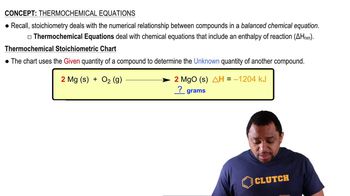
Thermochemical equations represent the heat changes associated with chemical reactions. They show the relationship between the enthalpy change (ΔH) and the stoichiometry of the reaction. In the context of formation reactions, these equations depict how one mole of a compound is formed from its elements in their standard states, allowing for the calculation of enthalpy changes during the formation process.
추천 영상:
가이드 코스
01:13
Thermochemical Equations

Standard State

The standard state of a substance refers to its physical state (solid, liquid, gas) at a defined set of conditions, typically 1 bar of pressure and a specified temperature, usually 25°C. For elements, the standard state is the most stable form at these conditions. Understanding standard states is crucial for accurately writing formation equations and determining standard enthalpy changes.
추천 영상:
가이드 코스
01:10
Standard Reduction Potentials

Enthalpy of Formation (ΔH°f)

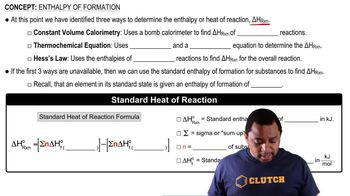
The enthalpy of formation (ΔH°f) is the change in enthalpy when one mole of a compound is formed from its elements in their standard states. It is a key thermodynamic quantity used to assess the stability of compounds and predict the heat released or absorbed during chemical reactions. Values of ΔH°f can be found in thermodynamic tables, which are essential for calculating reaction enthalpies.
추천 영상:
가이드 코스
02:34
Enthalpy of Formation