
Ch.5 - Thermochemistry
Brown - Chemistry: The Central Science 15th Edition
Brown15th EditionChemistry: The Central ScienceISBN: 9780137542970당신이 사용하는 게 아니라요?교과서 변경
5장, 문제 106b

A system consists of a sample of gas contained in a cylinder-and-piston arrangement. It undergoes the change in state shown in the drawing under two different situations: In Case 1, the cylinder and piston are perfect thermal insulators that do not allow heat to be transferred. In Case 2, the cylinder and piston are made up of a thermal conductor such as a metal, and during the state change, the cylinder gets warmer to the touch. Let 𝑞1,𝑤1, and Δ𝐸1 be the values of q, w, and Δ𝐸 for Case 1, and let 𝑞2,𝑤2, and Δ𝐸2 be the values for Case 2. b. What is the sign of 𝑤1?

검증된 단계별 안내
1
w represents the work done on or by the system. In thermodynamics, work done by the system on the surroundings is considered negative, while work done on the system by the surroundings is positive.
In Case 1, the system is a perfect thermal insulator, meaning no heat is exchanged with the surroundings (𝑞1 = 0).
The change in internal energy (Δ𝐸1) is related to work and heat by the first law of thermodynamics: Δ𝐸1 = 𝑞1 + 𝑤1.
Since 𝑞1 = 0, the equation simplifies to Δ𝐸1 = 𝑤1. The sign of 𝑤1 depends on whether the system does work on the surroundings or the surroundings do work on the system.
If the system expands, it does work on the surroundings, making 𝑤1 negative. If the system is compressed, the surroundings do work on it, making 𝑤1 positive. Determine the process (expansion or compression) to find the sign of 𝑤1.

비슷한 문제에 대한 검증된 영상 답변:

이 영상 해법은 위 문제에 도움이 된다고 튜터들이 추천한 것입니다.
영상 길이:
1m

주요 개념

질문에 올바르게 답하기 위해 반드시 이해해야 하는 핵심 개념들은 다음과 같습니다.

First Law of Thermodynamics

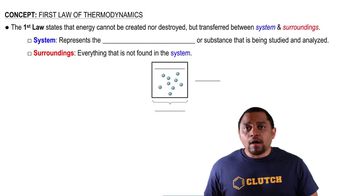
The First Law of Thermodynamics states that energy cannot be created or destroyed, only transformed from one form to another. In a closed system, the change in internal energy (ΔE) is equal to the heat added to the system (q) minus the work done by the system (w). This principle is crucial for analyzing energy changes in thermodynamic processes.
추천 영상:
가이드 코스
01:18
First Law of Thermodynamics

Work in Thermodynamics

In thermodynamics, work (w) is defined as the energy transferred when a force is applied over a distance. For a gas in a piston, work can be done on the gas (compression) or by the gas (expansion). The sign of work is conventionally positive when the system does work on the surroundings and negative when work is done on the system.
추천 영상:
가이드 코스
01:18
First Law of Thermodynamics

Adiabatic Process

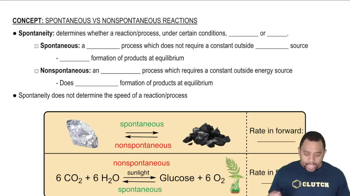
An adiabatic process is one in which no heat is exchanged with the surroundings, meaning the system is thermally insulated. In Case 1, since the cylinder and piston are perfect thermal insulators, the process is adiabatic. This affects the internal energy change and the work done, as any energy change must be accounted for solely by work, influencing the sign of w1.
추천 영상:
가이드 코스
04:20
Spontaneity of Processes
관련 실천
교과서 질문

A house is designed to have passive solar energy features. Brickwork incorporated into the interior of the house acts as a heat absorber. Each brick weighs approximately 1.8 kg. The specific heat of the brick is 0.85 J/g•K. How many bricks must be incorporated into the interior of the house to provide the same total heat capacity as 1.7⨉103 gal of water?

1818
views
교과서 질문

Consider a system consisting of the following apparatus, in which gas is confined in one flask and there is a vacuum in the other flask. The flasks are separated by a valve. Assume that the flasks are perfectly insulated and will not allow the flow of heat into or out of the flasks to the surroundings. When the valve is opened, gas flows from the filled flask to the evacuated one. (a) Is work performed during the expansion of the gas? (b) Why or why not?

467
views
교과서 질문

Potassium superoxide, KO2, is often used in oxygen masks (such as those used by firefighters) because KO2 reacts with CO2 to release molecular oxygen. Experiments indicate that 2 mol of KO2(s) react with each mole of CO2(g). (b) Indicate the oxidation number for each atom involved in the reaction in part (a). What elements are being oxidized and reduced?

985
views
교과서 질문

Two positively charged spheres, each with a charge of 2.0⨉10-5 C, a mass of 1.0 kg, and separated by a distance of 1.0 cm, are held in place on a frictionless track. (a) What is the electrostatic potential energy of this system?

1117
views
교과서 질문

The air bags that provide protection in automobiles in the event of an accident expand because of a rapid chemical reaction. From the viewpoint of the chemical reactants as the system, what do you expect for the signs of q and w in this process?

885
views