
A sodium ion, Na+, with a charge of 1.6⨉10-19 C and a chloride ion, Cl - , with charge of -1.6⨉10-19 C, are separated by a distance of 0.50 nm. How much work would be required to increase the separation of the two ions to an infinite distance?
Ch.5 - Thermochemistry

5장, 문제 15a
(a) The electrostatic force (not energy) of attraction between two oppositely charged objects is given by the equation F = k (Q1Q2/d2) where k = 8.99⨉109N-m2/C2, Q1 and Q2 are the charges of the two objects in Coulombs, and d is the distance separating the two objects in meters. What is the electrostatic force of attraction (in Newtons) between an electron and a proton that are separated by 1⨉102 pm?
검증된 단계별 안내1
Convert the distance from picometers to meters. Since 1 pm = 1⨉10^{-12} m, multiply 1⨉10^{2} pm by 1⨉10^{-12} m/pm to get the distance in meters.
Identify the charges of the electron and proton. The charge of an electron (Q_1) is -1.6⨉10^{-19} C, and the charge of a proton (Q_2) is +1.6⨉10^{-19} C.
Substitute the values of Q_1, Q_2, and the converted distance (d) into the formula F = k (Q_1Q_2/d^2).
Use the given value of k = 8.99⨉10^{9} N-m^2/C^2 in the formula.
Calculate the electrostatic force F by performing the multiplication and division as per the formula.

비슷한 문제에 대한 검증된 영상 답변:
이 영상 해법은 위 문제에 도움이 된다고 튜터들이 추천한 것입니다.
영상 길이:
3m도움이 되었나요?
주요 개념
질문에 올바르게 답하기 위해 반드시 이해해야 하는 핵심 개념들은 다음과 같습니다.
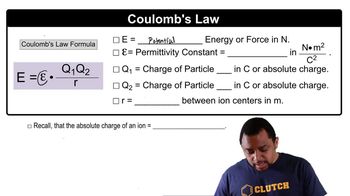
Coulomb's Law
Coulomb's Law describes the electrostatic force between two charged objects. It states that the force (F) is directly proportional to the product of the magnitudes of the charges (Q1 and Q2) and inversely proportional to the square of the distance (d) between them. The equation F = k(Q1Q2/d²) quantifies this relationship, where k is the electrostatic constant.
추천 영상:
가이드 코스
Coulomb's Law Concept 2
Units of Charge and Distance
In the context of electrostatics, charge is measured in Coulombs (C), while distance is typically measured in meters (m). The problem involves converting picometers (pm) to meters, as 1 pm equals 1×10⁻¹² m. Understanding these units is crucial for correctly applying Coulomb's Law and calculating the electrostatic force.
추천 영상:
가이드 코스
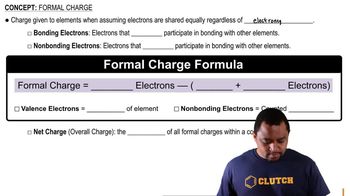
Formal Charge
Electrostatic Force Calculation
To calculate the electrostatic force between an electron and a proton, one must substitute the known values into Coulomb's Law. The charge of an electron is approximately -1.6×10⁻¹⁹ C, and that of a proton is +1.6×10⁻¹⁹ C. By using the distance of 1×10² pm (or 1×10⁻¹⁰ m), one can compute the force in Newtons, which indicates the strength of the attraction between these two fundamental particles.
추천 영상:
가이드 코스
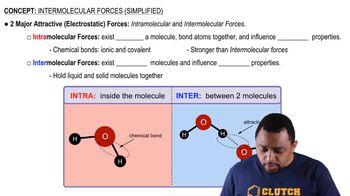
Intermolecular vs Intramolecular Forces
관련 실천
교과서 질문
2921
views
교과서 질문
(c) Does the potential energy of the two particles increase or decrease when the distance is increased to 1.0 nm?
762
views
교과서 질문
A magnesium ion, Mg2+, with a charge of 3.2⨉10-19 C and an oxide ion, O2-, with a charge of -3.2⨉10-19 C, are separated by a distance of 0.35 nm. How much work would be required to increase the separation of the two ions to an infinite distance?
1928
views
교과서 질문
(b) What is the change in potential energy if the distance separating the two electrons is increased to 1.0 nm?
838
views
교과서 질문
(a) What is the electrostatic potential energy (in joules) between two electrons that are separated by 62 pm?
691
views
