
Ch.5 - Thermochemistry
Brown - Chemistry: The Central Science 15th Edition
Brown15th EditionChemistry: The Central ScienceISBN: 9780137542970당신이 사용하는 게 아니라요?교과서 변경
5장, 문제 26a

Consider a system consisting of two oppositely charged spheres hanging by strings and separated by a distance r1, as shown in the accompanying illustration. Suppose they are separated to a larger distance r2, by moving them apart. (a) What change, if any, has occurred in the potential energy of the system?

검증된 단계별 안내
1
Identify the formula for the electric potential energy between two point charges: \(U = \frac{k \cdot q_1 \cdot q_2}{r}\), where \(k\) is Coulomb's constant, \(q_1\) and \(q_2\) are the charges, and \(r\) is the separation distance.
Recognize that the potential energy \(U\) is inversely proportional to the distance \(r\) between the charges.
Consider the initial potential energy \(U_1\) when the distance is \(r_1\): \(U_1 = \frac{k \cdot q_1 \cdot q_2}{r_1}\).
Consider the new potential energy \(U_2\) when the distance is increased to \(r_2\): \(U_2 = \frac{k \cdot q_1 \cdot q_2}{r_2}\).
Compare \(U_1\) and \(U_2\): Since \(r_2 > r_1\), \(U_2 < U_1\), indicating that the potential energy of the system has decreased.

비슷한 문제에 대한 검증된 영상 답변:

이 영상 해법은 위 문제에 도움이 된다고 튜터들이 추천한 것입니다.
영상 길이:
1m
도움이 되었나요?

주요 개념

질문에 올바르게 답하기 위해 반드시 이해해야 하는 핵심 개념들은 다음과 같습니다.

Electric Potential Energy

Electric potential energy is the energy stored in a system of charged particles due to their positions relative to each other. For two point charges, this energy is given by the formula U = k * (q1 * q2) / r, where k is Coulomb's constant, q1 and q2 are the magnitudes of the charges, and r is the distance between them. As the distance increases, the potential energy decreases for opposite charges, indicating that work is done against the electric force.
추천 영상:
가이드 코스
00:34
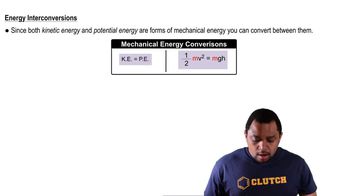
Kinetic & Potential Energy

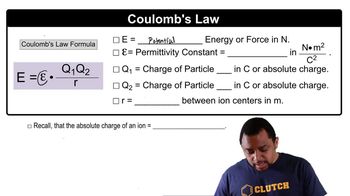
Coulomb's Law

Coulomb's Law describes the force between two charged objects, stating that the force is directly proportional to the product of the magnitudes of the charges and inversely proportional to the square of the distance between them. This law helps to understand how the force changes as the distance between the charges changes, which in turn affects the potential energy of the system.
추천 영상:
가이드 코스
01:15
Coulomb's Law Concept 2

Work and Energy Transfer

In physics, work is defined as the energy transferred when a force is applied over a distance. When the charged spheres are moved apart, work is done against the electric force, resulting in a change in potential energy. This concept is crucial for understanding how energy is conserved and transformed in electrostatic systems, particularly when charges are separated or brought closer together.
추천 영상:
가이드 코스
01:52
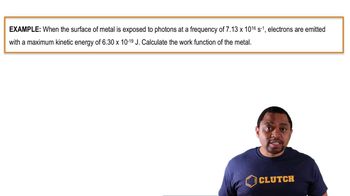
Work Function Calculation Example
관련 실천
교과서 질문

A gas is confined to a cylinder fitted with a piston and an electrical heater, as shown here:

Suppose that current is supplied to the heater so that 100 J of energy is added. Consider two different situations. In case (1) the piston is allowed to move as the energy is added. In case (2) the piston is fixed so that it cannot move. (b) Identify the sign (positive, negative, or zero) of q and w in each case?

511
views
교과서 질문

Imagine that you are climbing a mountain. Which of the following are state functions? b. The change in elevation during the climb

2
views
교과서 질문

Imagine that you are climbing a mountain. Which of the following are state functions? a. The distance you walk during your climb to the top

2
views
교과서 질문

A gas is confined to a cylinder fitted with a piston and an electrical heater, as shown here:

Suppose that current is supplied to the heater so that 100 J of energy is added. Consider two different situations. In case (1) the piston is allowed to move as the energy is added. In case (2) the piston is fixed so that it cannot move. (a) In which case does the gas have the higher temperature after addition of the electrical energy?

753
views
교과서 질문

During a normal breath, our lungs expand about 0.50 L against an external pressure of 1.0 atm. How much work is involved in this process (in J)?

3
views
교과서 질문

For the following processes, calculate the change in internal energy of the system and determine whether the process is endothermic or exothermic: (a) A balloon is cooled by removing 0.655 kJ of heat. It shrinks on cooling, and the atmosphere does 382 J of work on the balloon. (b) A 100.0-g bar of gold is heated from 25 °C to 50 °C during which it absorbs 322 J of heat. Assume the volume of the gold bar remains constant.

973
views