
Ethane, C2H6, is an alkane with one C─C bond and six C─H bonds (Section 2.9). a. Use enthalpies of formation given in Appendix C to calculate Δ𝐻 for the reaction C2H6(𝑔)→2C(𝑔)+6H(𝑔). b. Use the result from part (a) and the value of 𝐷(C─H) from Table 5.4 to estimate the bond enthalpy 𝐷(C─C). c. How large is the difference between the value calculated for in part (b) and the value given in Table 5.4?
Ch.5 - Thermochemistry

5장, 문제 89a
Consider the reaction 2 H2(g) + O2(g) → 2 H2O(l). (a) Use the bond enthalpies in Table 5.4 to estimate H for this reaction, ignoring the fact that water is in the liquid state.
검증된 단계별 안내1
Identify the bonds broken and formed in the reaction. In this case, the bonds broken are 2 H-H bonds and 1 O=O bond, and the bonds formed are 4 O-H bonds.
Use the bond enthalpy values from Table 5.4 to find the total energy required to break the bonds. Calculate the energy for breaking 2 H-H bonds and 1 O=O bond.
Calculate the total energy released when the new bonds are formed. This involves calculating the energy for forming 4 O-H bonds.
Apply the formula for the enthalpy change of the reaction: \( \Delta H = \text{Total energy of bonds broken} - \text{Total energy of bonds formed} \).
Substitute the calculated values into the formula to estimate \( \Delta H \) for the reaction.

비슷한 문제에 대한 검증된 영상 답변:
이 영상 해법은 위 문제에 도움이 된다고 튜터들이 추천한 것입니다.
영상 길이:
8m도움이 되었나요?
주요 개념
질문에 올바르게 답하기 위해 반드시 이해해야 하는 핵심 개념들은 다음과 같습니다.
Bond Enthalpy
Bond enthalpy, or bond dissociation energy, is the amount of energy required to break one mole of a specific type of bond in a gaseous molecule. It is a crucial concept in thermochemistry as it helps estimate the energy changes during chemical reactions. In the context of the given reaction, bond enthalpies for H-H and O=O bonds will be used to calculate the overall change in enthalpy (ΔH) by considering the energy required to break the bonds in reactants and the energy released when forming bonds in products.
추천 영상:
가이드 코스
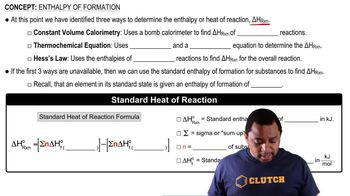
Enthalpy of Formation
Enthalpy Change (ΔH)
Enthalpy change (ΔH) is a measure of the heat content change in a system during a chemical reaction at constant pressure. It can be calculated using the formula ΔH = Σ(bond enthalpies of bonds broken) - Σ(bond enthalpies of bonds formed). This concept is essential for understanding the energy dynamics of the reaction, allowing us to predict whether the reaction is exothermic (releases heat) or endothermic (absorbs heat).
추천 영상:
가이드 코스
Enthalpy of Formation
State of Matter and Its Impact
The state of matter (solid, liquid, gas) significantly influences the energy associated with a substance. In this reaction, water is produced in the liquid state, but the question asks to ignore this fact. This simplification means we will treat water as if it were in the gaseous state for the purpose of calculating ΔH, which can lead to a different enthalpy value than if the liquid state were considered, as the enthalpy of vaporization would need to be accounted for.
추천 영상:
가이드 코스
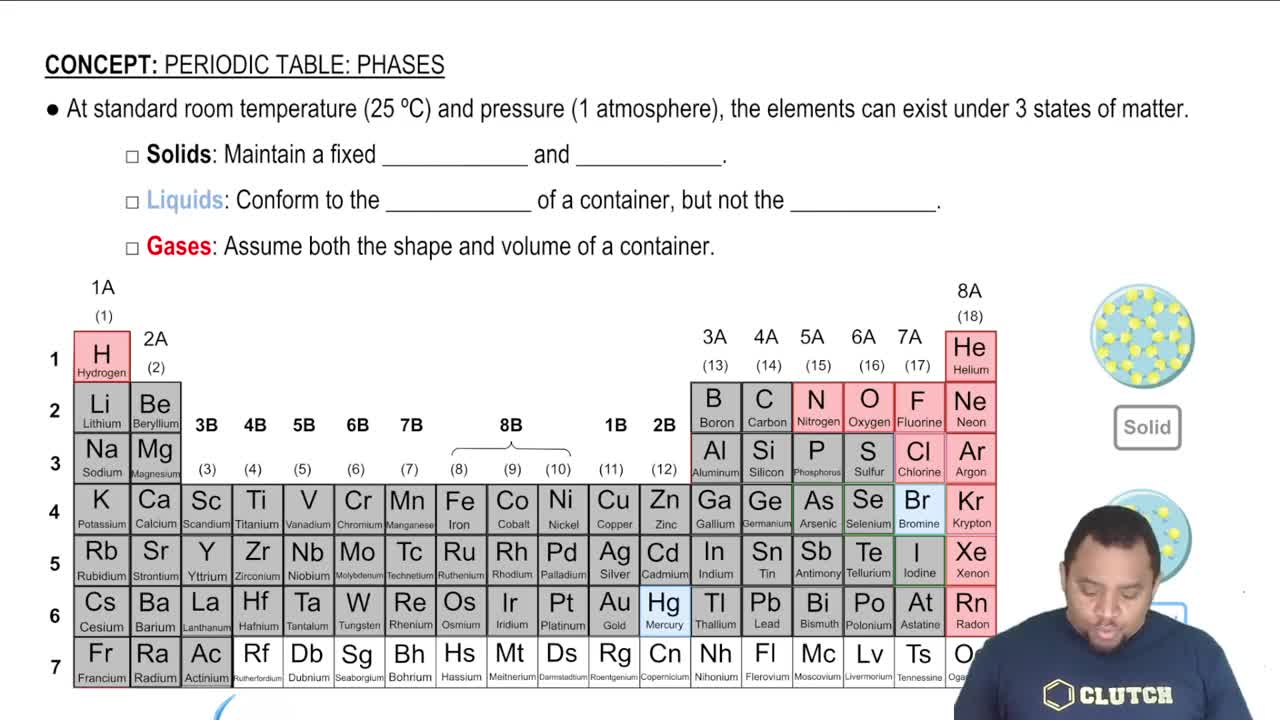
Element States of Matter
관련 실천
교과서 질문
교과서 질문
Methanol (CH3OH) is used as a fuel in race cars. (d) Calculate the mass of CO2 produced per kJ of heat emitted.
461
views
교과서 질문
Use bond enthalpies in Table 5.4 to estimate H for each of the following reactions: (a)
958
views
교과서 질문
(b) A particular chip snack food is composed of 12% protein, 14% fat, and the rest carbohydrate. What percentage of the calorie content of this food is fat?
1241
views
