
Ch.5 - Thermochemistry
Brown - Chemistry: The Central Science 15th Edition
Brown15th EditionChemistry: The Central ScienceISBN: 9780137542970당신이 사용하는 게 아니라요?교과서 변경
5장, 문제 117

The hydrocarbons cyclohexane (C6H12), ΔHf° = -156 kJ/mol, and 1-hexene (C6H12), ΔHf° = -74 kJ/mol, have the same empirical formula. (a) Calculate the standard enthalpy change for the transformation of cyclohexane to 1-hexene. (b) Which has greater enthalpy, cyclohexane or 1-hexene?

검증된 단계별 안내
1
Step 1: Understand the problem by identifying the given data: Cyclohexane (C6H12) has a standard enthalpy of formation (ΔHf°) of -156 kJ/mol, and 1-hexene (C6H12) has a ΔHf° of -74 kJ/mol.
Step 2: To find the standard enthalpy change (ΔH°) for the transformation of cyclohexane to 1-hexene, use the formula: ΔH° = ΔHf°(products) - ΔHf°(reactants).
Step 3: Substitute the given values into the formula: ΔH° = (-74 kJ/mol) - (-156 kJ/mol).
Step 4: Simplify the expression by subtracting the enthalpy of formation of cyclohexane from that of 1-hexene.
Step 5: To determine which compound has greater enthalpy, compare the ΔHf° values: the compound with the less negative (or more positive) ΔHf° has greater enthalpy.

주요 개념

질문에 올바르게 답하기 위해 반드시 이해해야 하는 핵심 개념들은 다음과 같습니다.

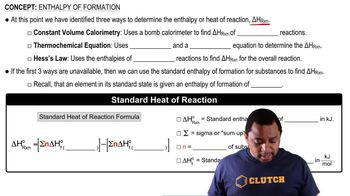
Standard Enthalpy of Formation (ΔHf°)

The standard enthalpy of formation (ΔHf°) is the change in enthalpy when one mole of a compound is formed from its elements in their standard states. It provides a reference point for calculating the enthalpy changes in chemical reactions. In this question, the ΔHf° values for cyclohexane and 1-hexene are essential for determining the enthalpy change during the transformation between these two hydrocarbons.
추천 영상:
가이드 코스
02:34
Enthalpy of Formation

Enthalpy Change (ΔH)

Enthalpy change (ΔH) is the heat content change associated with a chemical reaction at constant pressure. It can be calculated using the formula ΔH = ΣΔHf°(products) - ΣΔHf°(reactants). In this case, the enthalpy change for the transformation from cyclohexane to 1-hexene can be determined by subtracting the ΔHf° of cyclohexane from that of 1-hexene.
추천 영상:
가이드 코스
02:34
Enthalpy of Formation

Comparison of Enthalpy Values

Comparing the enthalpy values of different compounds helps determine their stability and energy content. A compound with a lower ΔHf° is generally more stable and has lower energy than one with a higher ΔHf°. In this question, analyzing the ΔHf° values of cyclohexane and 1-hexene allows us to conclude which compound has greater enthalpy and thus is less stable.
추천 영상:
가이드 코스
02:34
Enthalpy of Formation
관련 실천
교과서 질문

The Sun supplies about 1.0 kilowatt of energy for each square meter of surface area (1.0 kW/m2, where a watt=1 J/s). Plants produce the equivalent of about 0.20 g of sucrose (C12H22O11) per hour per square meter. Assuming that the sucrose is produced as follows, calculate the percentage of sunlight used to produce sucrose. 12 CO2(g) + 11 H2O(l) → C12H22O11 + 12 O2(g) H = 5645 kJ

3
views
교과서 질문

Consider two solutions, the first being 50.0 mL of 1.00 M CuSO4 and the second 50.0 mL of 2.00 M KOH. When the two solutions are mixed in a constant-pressure calorimeter, a precipitate forms and the temperature of the mixture rises from 21.5 to 27.7 °C. (a) Before mixing, how many grams of Cu are present in the solution of CuSO4?

980
views
교과서 질문

Depending on their specific usage, fuels are judged in part on energy released per unit volume and energy released per unit mass. Three prospective fuels are listed in the following table, along with their densities and molar enthalpies of combustion.

a. Rank the three fuels according to their enthalpy produced per gram.

b. Rank them according to their enthalpy produced per cm3:

3
views
교과서 질문

At 20 °C (approximately room temperature) the average velocity of N2 molecules in air is 1050 mph. (b) What is the kinetic energy (in J) of an N2 molecule moving at this speed?

1356
views
1
comments
교과서 질문

Use average bond enthalpies from Table 5.4 to estimate Δ𝐻 for the following gas-phase reaction of ethylene, (C2H4), oxygen, and hydrogen to form ethylene glycol (C2H6O2), which is the principal component of automotive antifreeze: