Ch.6 - Electronic Structure of Atoms
Brown - Chemistry: The Central Science 15th Edition
Brown15th EditionChemistry: The Central ScienceISBN: 9780137542970당신이 사용하는 게 아니라요?교과서 변경
6장, 문제 59b

A certain orbital of the hydrogen atom has n = 4 and l = 2. b. What are the possible values of ms for the orbital?

검증된 단계별 안내
1
Identify the quantum numbers involved: n (principal quantum number), l (azimuthal quantum number), m_l (magnetic quantum number), and m_s (spin quantum number).
Understand that the spin quantum number, m_s, describes the intrinsic angular momentum (or spin) of an electron within an orbital.
Recall that the possible values for m_s are always +\(\frac{1}{2}\) and -\(\frac{1}{2}\), regardless of the values of n, l, or m_l.
Note that the problem specifies an orbital with n = 4 and l = 2, but these do not affect the possible values of m_s.
Conclude that the possible values of m_s for any electron in any orbital are +\(\frac{1}{2}\) and -\(\frac{1}{2}\).

비슷한 문제에 대한 검증된 영상 답변:

이 영상 해법은 위 문제에 도움이 된다고 튜터들이 추천한 것입니다.
영상 길이:
1m

주요 개념

질문에 올바르게 답하기 위해 반드시 이해해야 하는 핵심 개념들은 다음과 같습니다.

Quantum Numbers

Quantum numbers are a set of numerical values that describe the unique quantum state of an electron in an atom. The principal quantum number (n) indicates the energy level, while the azimuthal quantum number (l) defines the shape of the orbital. For each value of l, there are specific allowed values for the magnetic quantum number (m_l) and the spin quantum number (m_s).
추천 영상:
가이드 코스
02:55
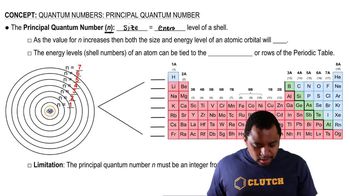
Principal Quantum Number

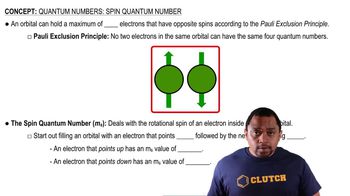
Spin Quantum Number (m_s)

The spin quantum number (m_s) describes the intrinsic angular momentum or 'spin' of an electron within an orbital. It can take on one of two values: +1/2 or -1/2, representing the two possible orientations of the electron's spin. This concept is crucial for understanding the behavior of electrons in magnetic fields and the overall electron configuration of atoms.
추천 영상:
가이드 코스
01:18
Spin Quantum Number

Orbital Types and Their Characteristics

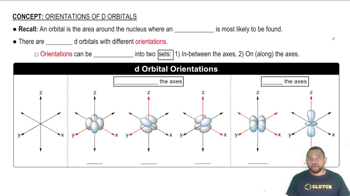
Orbitals are regions in an atom where there is a high probability of finding electrons. The type of orbital is determined by the azimuthal quantum number (l), where l = 0 corresponds to s orbitals, l = 1 to p orbitals, l = 2 to d orbitals, and l = 3 to f orbitals. In this case, with n = 4 and l = 2, we are dealing with a 4d orbital, which can hold a maximum of 10 electrons, each with a unique set of quantum numbers.
추천 영상:
가이드 코스
02:06
d Orbital Orientations