(a) For an He+ ion, do the 2s and 2p orbitals have the same energy? If not, which orbital has a lower energy?
Ch.6 - Electronic Structure of Atoms

6장, 문제 66a
(a) With reference to Figure 6.19, what is the relationship between the number of nodes in an s orbital and the value of the principal quantum number?

검증된 단계별 안내1
Examine the provided graphs for the 1s, 2s, and 3s orbitals, noting the number of nodes in each.
Identify that the 1s orbital has 0 nodes, the 2s orbital has 1 node, and the 3s orbital has 2 nodes.
Recall that the principal quantum number (n) represents the energy level of the orbital.
Understand that the number of nodes in an s orbital is given by the formula: number of nodes = n - 1.
Conclude that as the principal quantum number (n) increases, the number of nodes in the s orbital also increases according to the relationship: number of nodes = n - 1.

비슷한 문제에 대한 검증된 영상 답변:
이 영상 해법은 위 문제에 도움이 된다고 튜터들이 추천한 것입니다.
영상 길이:
1m주요 개념
질문에 올바르게 답하기 위해 반드시 이해해야 하는 핵심 개념들은 다음과 같습니다.
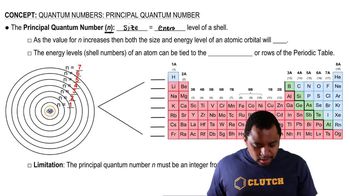
Principal Quantum Number (n)
The principal quantum number (n) indicates the energy level of an electron in an atom and is a positive integer (1, 2, 3, ...). As n increases, the electron's average distance from the nucleus increases, leading to higher energy levels. Each value of n corresponds to a different electron shell, with higher n values allowing for more complex orbital shapes and sizes.
추천 영상:
가이드 코스
Principal Quantum Number
Nodes in Orbitals
Nodes are regions in an atomic orbital where the probability of finding an electron is zero. The number of nodes in an orbital is directly related to the principal quantum number; specifically, the number of nodes increases as n increases. For s orbitals, the number of nodes is given by the formula n-1, meaning that a 1s orbital has no nodes, a 2s has one node, and a 3s has two nodes.
추천 영상:
가이드 코스
Radial Nodes Example
s Orbitals
s orbitals are spherical in shape and are characterized by their principal quantum number. Each s orbital can hold a maximum of two electrons and has a specific number of nodes based on its n value. The graphical representation of s orbitals shows how the probability of finding an electron varies with distance from the nucleus, highlighting the presence of nodes as the principal quantum number increases.
추천 영상:
가이드 코스
Molecular Orbital Theory
관련 실천
교과서 질문
862
views
교과서 질문
(b) If we add one electron to form the He atom, would your answer to part (a) change?
917
views
교과서 질문
For the table that follows, write which orbital goes with the quantum numbers. Don't worry about x, y, z subscripts. If the quantum numbers are not allowed, write 'not allowed.' n l ml Orbital 2 1 -1 2p (example) 1 0 0 3 -3 2 3 2 -2 2 0 -1 0 0 0 4 2 1 5 3 0
1056
views
교과서 질문
Sketch the shape and orientation of the following types of orbitals: (a) px, (b) dz2, (c) dx2 - y2.
533
views
교과서 질문
(a) The average distance from the nucleus of a 3s electron in a chlorine atom is smaller than that for a 3p electron. In light of this fact, which orbital is higher in energy?
1123
views
교과서 질문
Sketch the shape and orientation of the following types of orbitals: (a) s, (b) pz, (c) dxy.
1177
views