Ch.6 - Electronic Structure of Atoms
Brown - Chemistry: The Central Science 15th Edition
Brown15th EditionChemistry: The Central ScienceISBN: 9780137542970당신이 사용하는 게 아니라요?교과서 변경
6장, 문제 81a1

Consider the two waves shown here, which we will consider to represent two electromagnetic radiations: (a) What is the wavelength of wave A?
Two electromagnetic wave graphs illustrating wavelength; wave A's wavelength is 2.56 x 10^-6 m.

검증된 단계별 안내
1
Identify the wave labeled as 'A' in the image. In this case, it is the wave labeled as (i).
Understand that the wavelength (\
\(\lambda\)\
\) is the distance between two consecutive peaks or troughs of the wave.
Observe the given scale in the image, which shows that the distance for wave (ii) is 2.56 x 10^-6 meters.
Count the number of wavelengths for wave (ii) within the given distance. In this case, there are two complete wavelengths for wave (ii).
Since wave (i) has twice the number of wavelengths as wave (ii) within the same distance, the wavelength of wave (i) is half of 2.56 x 10^-6 meters.

비슷한 문제에 대한 검증된 영상 답변:

이 영상 해법은 위 문제에 도움이 된다고 튜터들이 추천한 것입니다.
영상 길이:
1m
도움이 되었나요?

주요 개념

질문에 올바르게 답하기 위해 반드시 이해해야 하는 핵심 개념들은 다음과 같습니다.

Wavelength

Wavelength is the distance between successive crests (or troughs) of a wave, typically measured in meters. It is a fundamental property of waves, including electromagnetic radiation, and is inversely related to frequency. The longer the wavelength, the lower the frequency, and vice versa. In the context of electromagnetic waves, wavelength determines the type of radiation, such as radio waves, visible light, or gamma rays.
추천 영상:
가이드 코스
00:31
Frequency-Wavelength Relationship

Electromagnetic Spectrum

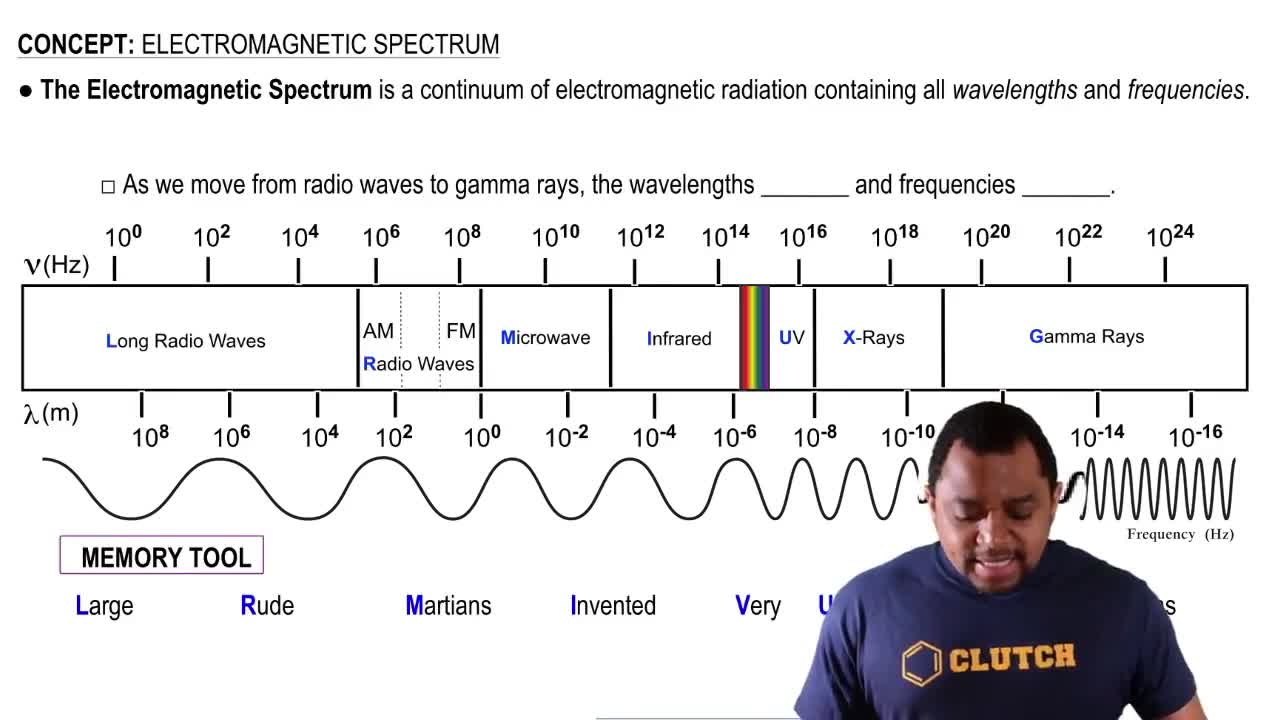
The electromagnetic spectrum encompasses all types of electromagnetic radiation, arranged by wavelength or frequency. It includes a range of waves from radio waves with long wavelengths to gamma rays with very short wavelengths. Understanding where a specific wavelength falls within this spectrum helps in identifying its properties and applications, such as communication, medical imaging, or heating.
추천 영상:
가이드 코스
02:53
Electromagnetic Spectrum

Wave Properties

Waves exhibit several key properties, including amplitude, frequency, and wavelength. Amplitude refers to the height of the wave, indicating its energy, while frequency is the number of cycles that pass a point per second. These properties are interrelated; for instance, a wave's speed is the product of its frequency and wavelength. Understanding these properties is essential for analyzing wave behavior and interactions.
추천 영상:
가이드 코스
02:54
Physical Properties
관련 실천
교과서 질문

Consider the two waves shown here, which we will consider to represent two electromagnetic radiations: (b) What is the frequency of wave A?

605
views

교과서 질문

Identify the specific element that corresponds to each of the following electron configurations and indicate the number of unpaired electrons for each: (d) 3Kr45s24d105p4.

387
views
교과서 질문

Certain elements emit light of a specific wavelength when they are burned or heated in a non-luminous flame. Historically, chemists used such emission wavelengths to determine whether specific elements were present in a sample. Some characteristic wavelengths for a few of the elements are given in the following table:

Ag 328.1 nm Fe 372.0 nm

Au 267.6 nm K 404.7 nm

Ba 455.4 nm Mg 285.2 nm

Ca 422.7 nm Na 589.6 nm

Cu 324.8 nm Ni 341.5 nm

(c) When burned, a sample of an unknown substance is found to emit light of frequency 6.58 * 1014 s-1. Which of these elements is probably in the sample?

3
views
교과서 질문

The following electron configurations represent excited states. Identify the element and write its ground-state condensed electron configuration. (b) 3Ar44s13d104p25p1

3
views
교과서 질문

If you put 120 volts of electricity through a pickle, the pickle will smoke and start glowing orange-yellow. The light is emitted because sodium ions in the pickle become excited; their return to the ground state results in light emission. b. What is the energy of 1.00 mol of these photons? (A mole of photons is called an Einstein.)

3
views
교과서 질문

The following do not represent valid ground-state electron configurations for an atom either because they violate the Pauli exclusion principle or because orbitals are not filled in order of increasing energy. Indicate which of these two principles is violated in each example. b. 3Xe46s25d4

3
views