Using Heisenberg’s uncertainty principle, calculate the uncertainty in the position of b. a proton moving at a speed of (5.00±0.01) × 104 m/s. The mass of a proton is 1.673×10⁻²⁷ kg.
Ch.6 - Electronic Structure of Atoms

6장, 문제 56b
How many unique combinations of the quantum numbers l and 𝑚𝑙 are there when b. n = 4?
검증된 단계별 안내1
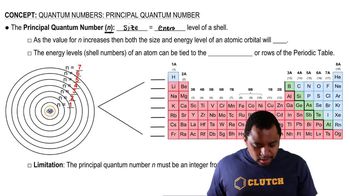
n is the principal quantum number, and it determines the energy level of an electron in an atom. For n = 4, the possible values of the azimuthal quantum number l range from 0 to n - 1.
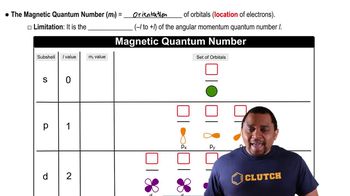
For each value of l, the magnetic quantum number ml can take integer values from -l to +l, including zero.
Calculate the number of possible ml values for each l value. For example, if l = 0, ml can only be 0, giving 1 combination.
Continue this process for l = 1, 2, and 3, calculating the number of ml values for each.
Sum the number of combinations for each l value to find the total number of unique combinations of l and ml when n = 4.

비슷한 문제에 대한 검증된 영상 답변:
이 영상 해법은 위 문제에 도움이 된다고 튜터들이 추천한 것입니다.
영상 길이:
3m주요 개념
질문에 올바르게 답하기 위해 반드시 이해해야 하는 핵심 개념들은 다음과 같습니다.
Quantum Numbers
Quantum numbers are sets of numerical values that describe the unique quantum state of an electron in an atom. They include the principal quantum number (n), azimuthal quantum number (l), magnetic quantum number (ml), and spin quantum number (ms). Each quantum number provides specific information about the electron's energy level, shape of the orbital, orientation, and spin.
추천 영상:
가이드 코스
Principal Quantum Number
Azimuthal Quantum Number (l)
The azimuthal quantum number (l) determines the shape of an electron's orbital and can take on integer values from 0 to n-1, where n is the principal quantum number. For n = 4, l can be 0, 1, 2, or 3, corresponding to the s, p, d, and f orbitals, respectively. Each value of l defines a different type of orbital with distinct shapes.
추천 영상:
가이드 코스
Magnetic Quantum Number
Magnetic Quantum Number (ml)
The magnetic quantum number (ml) specifies the orientation of an orbital in space and can take on integer values ranging from -l to +l, including zero. For each value of l, there are 2l + 1 possible values of ml. For example, if l = 2 (d orbital), ml can be -2, -1, 0, +1, or +2, resulting in five unique orientations.
추천 영상:
가이드 코스
Magnetic Quantum Number
관련 실천
교과서 질문
1
views
교과서 질문
(a) For n = 4, what are the possible values of l?
1164
views
교과서 질문
Give the values for n, l, and 𝑚𝑙 for a. each orbital in the 2p subshell
2
views
교과서 질문
Calculate the uncertainty in the position of (a) an electron moving at a speed of 13.00 ± 0.012 × 10⁵ m/s (b) a neutron moving at this same speed. (The masses of an electron and a neutron are given in the table of fundamental constants in the inside cover of the text.)
900
views
1
rank
교과서 질문
Give the numerical values of n and l corresponding to each of the following orbital designations: (a) 3p (b) 2s (c) 4f
505
views
교과서 질문
Give the numerical values of n and l corresponding to each of the following orbital designations: (d) 5d.
791
views