(a) Calculate the energy of a photon of electromagnetic radiation whose frequency is 2.94 × 10¹⁴ s-1.
Ch.6 - Electronic Structure of Atoms

6장, 문제 22
It is possible to convert radiant energy into electrical energy using photovoltaic cells. Assuming equal efficiency of conversion, would infrared or ultraviolet radiation yield more electrical energy on a per-photon basis?
검증된 단계별 안내1
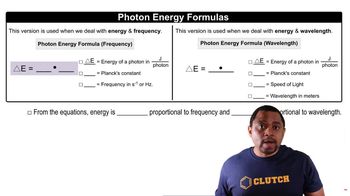
Understand that the energy of a photon is given by the equation: \(E = h \nu = \frac{hc}{\lambda}\), where \(E\) is the energy, \(h\) is Planck's constant, \(\nu\) is the frequency, \(c\) is the speed of light, and \(\lambda\) is the wavelength.
Recognize that ultraviolet (UV) radiation has a shorter wavelength than infrared (IR) radiation. This means that for UV radiation, \(\lambda\) is smaller compared to IR radiation.
Since the energy of a photon is inversely proportional to its wavelength (\(E \propto \frac{1}{\lambda}\)), photons with shorter wavelengths (like UV) have higher energy than those with longer wavelengths (like IR).
Conclude that on a per-photon basis, ultraviolet radiation would yield more electrical energy than infrared radiation, assuming equal efficiency of conversion.
Consider the practical implications: while UV photons have more energy, the efficiency of photovoltaic cells can vary based on the material and design, which might affect the overall energy conversion.

비슷한 문제에 대한 검증된 영상 답변:
이 영상 해법은 위 문제에 도움이 된다고 튜터들이 추천한 것입니다.
영상 길이:
1m도움이 되었나요?
주요 개념
질문에 올바르게 답하기 위해 반드시 이해해야 하는 핵심 개념들은 다음과 같습니다.
Photon Energy
The energy of a photon is directly related to its frequency and inversely related to its wavelength, as described by the equation E = hν, where E is energy, h is Planck's constant, and ν is frequency. Higher frequency radiation, such as ultraviolet (UV), has more energy per photon compared to lower frequency radiation, like infrared (IR). This fundamental principle is crucial for understanding how different types of radiation can be converted into electrical energy.
추천 영상:
가이드 코스
Photon Energy Formulas
Photovoltaic Effect
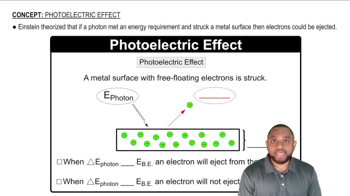
The photovoltaic effect is the process by which certain materials convert light energy into electrical energy. When photons strike a photovoltaic cell, they can excite electrons, creating electron-hole pairs that generate a flow of electricity. The efficiency of this conversion depends on the energy of the incoming photons, making it essential to consider the type of radiation when evaluating energy output.
추천 영상:
가이드 코스
Photoelectric Effect
Energy Conversion Efficiency
Energy conversion efficiency refers to the ratio of useful electrical energy output to the total energy input from radiation. In the context of photovoltaic cells, this efficiency can vary based on the wavelength of the incoming light. Since UV photons carry more energy than IR photons, assuming equal conversion efficiency, UV radiation would yield more electrical energy per photon than IR radiation, highlighting the importance of wavelength in energy conversion.
추천 영상:
가이드 코스
Conversion Factors
관련 실천
교과서 질문
834
views
교과서 질문
(b) Calculate the energy of a photon of radiation whose wavelength is 413 nm.
1040
views
교과서 질문
If human height were quantized in 1-foot increments, what would happen to the height of a child as she grew up?
a. The child’s height would never change.
b. The child’s height would continuously get greater.
c. The child’s height would increase in “jumps” of 1 foot at a time.
d. The child’s height would increase in jumps of 6 inches.
3
views
교과서 질문
A laser pointer used in a lecture hall emits light at 650 nm. What is the frequency of this radiation?
806
views
교과서 질문
(d) What distance does electromagnetic radiation travel in 0.38 ps?
901
views
교과서 질문
A laser pointer used in a lecture hall emits light at 650 nm. Using Figure 6.4, predict the color associated with this wavelength.
753
views