Label each of the following statements as true or false. a. Visible light is a form of electromagnetic radiation.
Ch.6 - Electronic Structure of Atoms

6장, 문제 12
State where in the periodic table these elements appear: (a) elements with the valence-shell electron configuration ns2np5 (b) elements that have three unpaired p electrons (c) an element whose valence electrons are 4s24p1 (d) the d-block elements [Section 6.9]
검증된 단계별 안내1
Identify the general electron configuration for each case and relate it to the periodic table sections: s-block, p-block, d-block, and f-block.
For part (a), recognize that the electron configuration ns2np5 corresponds to halogens, which are located in Group 17 of the p-block.
For part (b), elements with three unpaired p electrons typically have a p3 configuration, placing them in Group 15 of the p-block.
For part (c), the electron configuration 4s24p1 indicates an element in the 4th period of the p-block, specifically in Group 13.
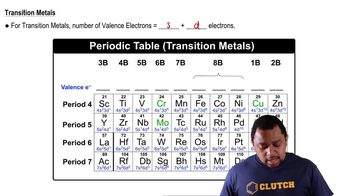
For part (d), understand that the d-block elements are transition metals, which are found in the central block of the periodic table, specifically Groups 3 through 12.

비슷한 문제에 대한 검증된 영상 답변:
이 영상 해법은 위 문제에 도움이 된다고 튜터들이 추천한 것입니다.
영상 길이:
3m도움이 되었나요?
주요 개념
질문에 올바르게 답하기 위해 반드시 이해해야 하는 핵심 개념들은 다음과 같습니다.
Valence Electron Configuration
Valence electron configuration describes the distribution of electrons in the outermost shell of an atom. The notation 'ns2np5' indicates that the element has two electrons in the s subshell and five in the p subshell of its highest energy level, which corresponds to the halogens in Group 17 of the periodic table.
추천 영상:
가이드 코스
Transition Metals Valence Electrons
Unpaired Electrons
Unpaired electrons are those that occupy an orbital alone rather than in pairs. Elements with three unpaired p electrons typically belong to Group 15 of the periodic table, where the p subshell has three electrons, leading to unique chemical properties and reactivity.
추천 영상:
가이드 코스
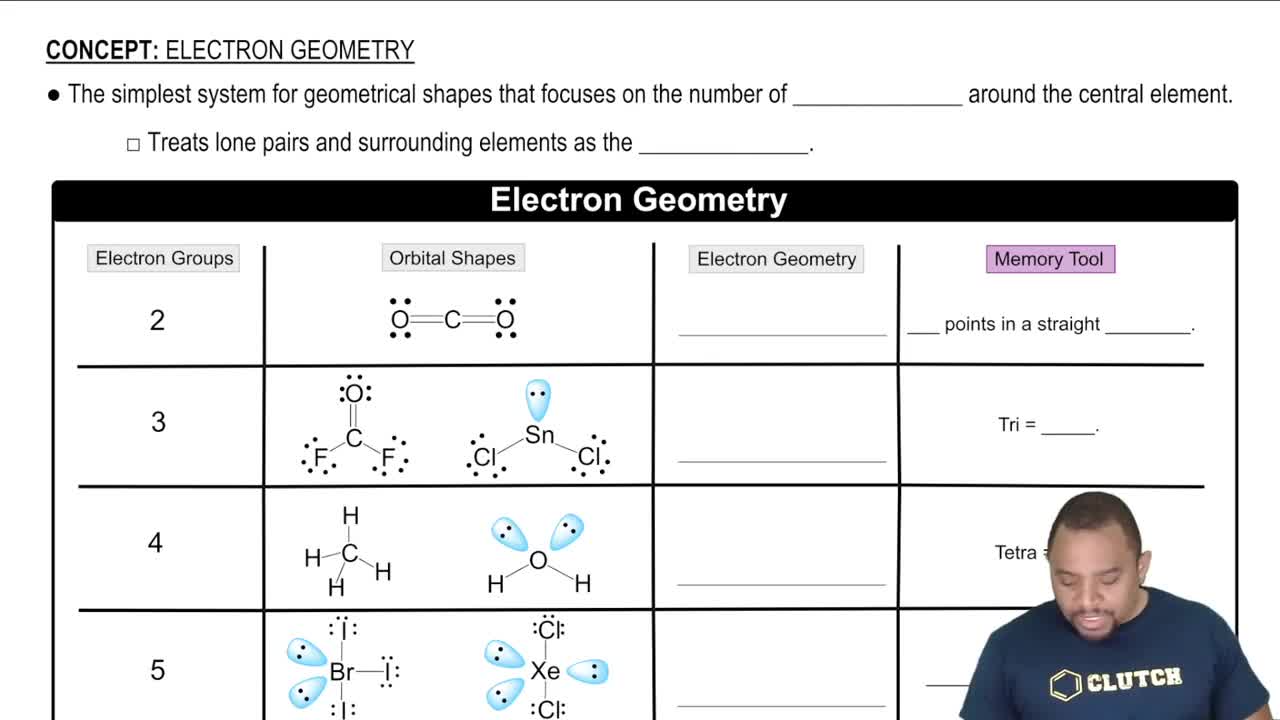
Electron Geometry
d-block Elements
The d-block elements, also known as transition metals, are found in Groups 3 to 12 of the periodic table. These elements are characterized by the filling of d orbitals and exhibit properties such as variable oxidation states and the ability to form colored compounds, making them essential in various chemical reactions and applications.
추천 영상:
가이드 코스
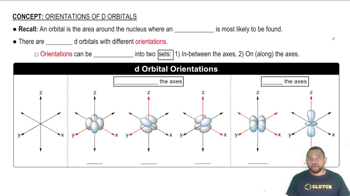
d Orbital Orientations
관련 실천
교과서 질문
2
views
교과서 질문
Four possible electron configurations for a nitrogen atom are shown below, but only one schematic represents the correct configuration for a nitrogen atom in its ground state. Which configurations violate the Pauli exclusion principle?
751
views
교과서 질문
Four possible electron configurations for a carbon atom are shown below, but only one schematic represents the correct configuration for a carbon atom in its ground state. Which one is the correct electron configuration?
2654
views
1
rank
1
comments
교과서 질문
The accompanying drawing shows a contour plot for a dyz orbital. Consider the quantum numbers that could potentially correspond to this orbital. (d) The probability density goes to zero along which of the following planes: xy, xz, or yz?
737
views