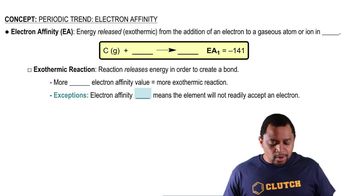
rue or false: If the electron affinity for an element is a negative number, then the anion of the element is more stable than the neutral atom.
Ch.7 - Periodic Properties of the Elements

7장, 문제 41
a. Write an equation for the second electron affinity of chlorine.
b. Would you predict a positive or a negative quantity for this process?
검증된 단계별 안내1
Step 1: Understand the concept of electron affinity. Electron affinity is the energy change that occurs when an electron is added to a neutral atom in the gas phase to form a negative ion. The first electron affinity is usually exothermic (releases energy) because the added electron is attracted to the positively charged nucleus.
Step 2: Define the second electron affinity. The second electron affinity refers to the energy change when an additional electron is added to a negatively charged ion. This process is generally endothermic (requires energy) because the added electron experiences repulsion from the negatively charged ion.
Step 3: Write the chemical equation for the second electron affinity of chlorine. Start with the chloride ion (Cl-) and add an electron to form the Cl2- ion: \[ \text{Cl}^- (g) + e^- \rightarrow \text{Cl}^{2-} (g) \]
Step 4: Predict the sign of the second electron affinity. Since the second electron is being added to an already negatively charged ion, it will experience repulsion, making the process endothermic. Therefore, the second electron affinity is expected to be a positive quantity.
Step 5: Summarize the findings. The second electron affinity of chlorine involves adding an electron to Cl- to form Cl2-, and this process is endothermic, resulting in a positive energy change.

비슷한 문제에 대한 검증된 영상 답변:
이 영상 해법은 위 문제에 도움이 된다고 튜터들이 추천한 것입니다.
영상 길이:
4m도움이 되었나요?
주요 개념
질문에 올바르게 답하기 위해 반드시 이해해야 하는 핵심 개념들은 다음과 같습니다.
Electron Affinity
Electron affinity is the energy change that occurs when an electron is added to a neutral atom in the gas phase. For most elements, this process releases energy, resulting in a negative value for electron affinity. However, the second electron affinity refers to the addition of a second electron to an already negatively charged ion, which typically requires energy input due to the repulsion between the negatively charged particles.
추천 영상:
가이드 코스
Electron Affinity
Chlorine's Electron Configuration
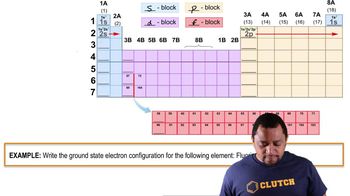
Chlorine has an atomic number of 17, with an electron configuration of [Ne]3s²3p⁵. When it gains one electron, it achieves a stable noble gas configuration, becoming Cl⁻. The addition of a second electron to Cl⁻ (to form Cl²⁻) encounters increased electron-electron repulsion, making this process less favorable and typically resulting in a positive electron affinity value.
추천 영상:
가이드 코스
Electron Configuration Example
Energy Considerations in Ion Formation
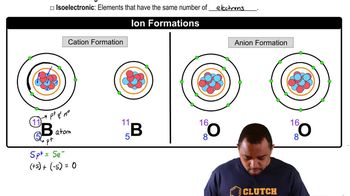
The energy associated with ion formation is crucial in determining whether a process is exothermic or endothermic. For the first electron affinity of chlorine, energy is released, making it negative. However, for the second electron affinity, energy must be supplied to overcome the repulsion between the negatively charged ion and the incoming electron, leading to a positive value for this process.
추천 영상:
가이드 코스
Ion Formation
관련 실천
교과서 질문
2
views
교과서 질문
Based on their positions in the periodic table, predict which atom of the following pairs will have the smaller first ionization energy: (a) Br, Kr (b) C, Ca (c) Li, Rb (d) S, Ge (e) Al, B.
731
views
교과서 질문
Write equations that show the processes that describe the first, second, and third ionization energies of an aluminum atom. Which process would require the least amount of energy?
2
views
교과서 질문
Which of the ions Ni2+, Fe2+, Co3+, and Pt2+ has an electron configuration of 𝑛𝑑6(𝑛=3,4,5,…)?
a. Ni2+
b. Fe2+
c. Co3+
d. Pt2+
e. More than one of these
2
views
교과서 질문
Write the electron configurations for the following ions, and determine which have noble-gas configurations.
a. Ru3+
b. As3−
c. Y3+
d. Pd2+
e. Pb2+
f. Au3+
2
views