Ch.7 - Periodic Properties of the Elements
Brown - Chemistry: The Central Science 15th Edition
Brown15th EditionChemistry: The Central ScienceISBN: 9780137542970당신이 사용하는 게 아니라요?교과서 변경
7장, 문제 46

Identify each statement as true or false.
a. Ionization energies are always negative quantities.
b. Oxygen has a larger first ionization energy than fluorine.
c. The second ionization energy of an atom is always greater than its first ionization energy.
d. The third ionization energy is the energy needed to ionize three electrons from a neutral atom.

검증된 단계별 안내
1
Ionization energy is the energy required to remove an electron from an atom or ion. It is always a positive quantity because energy must be supplied to overcome the attraction between the electron and the nucleus. Therefore, statement a is false.
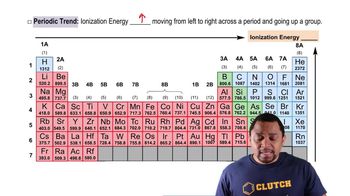
The first ionization energy generally increases across a period from left to right due to increasing nuclear charge. Since fluorine is to the right of oxygen in the periodic table, fluorine has a larger first ionization energy than oxygen. Therefore, statement b is false.
The second ionization energy is the energy required to remove a second electron after the first has been removed. It is always greater than the first ionization energy because the electron is being removed from a positively charged ion, which has a stronger attraction to the remaining electrons. Therefore, statement c is true.
The third ionization energy refers to the energy required to remove a third electron after the first two have been removed, not the energy needed to remove three electrons simultaneously. Therefore, statement d is false.

비슷한 문제에 대한 검증된 영상 답변:

이 영상 해법은 위 문제에 도움이 된다고 튜터들이 추천한 것입니다.
영상 길이:
57s
도움이 되었나요?

주요 개념

질문에 올바르게 답하기 위해 반드시 이해해야 하는 핵심 개념들은 다음과 같습니다.

Ionization Energy

Ionization energy is the energy required to remove an electron from a gaseous atom or ion. It is always a positive value because energy must be supplied to overcome the attraction between the negatively charged electron and the positively charged nucleus. Therefore, the statement that ionization energies are always negative is false.
추천 영상:
가이드 코스
01:19
Ionization Energy

Trends in Ionization Energy

Ionization energy generally increases across a period in the periodic table due to increasing nuclear charge, which holds electrons more tightly. Conversely, it decreases down a group as additional electron shells are added, increasing distance from the nucleus. Thus, the statement regarding oxygen having a larger first ionization energy than fluorine is false, as fluorine has a higher ionization energy.
추천 영상:
가이드 코스
01:08
Ionization Energy Trends

Successive Ionization Energies

Successive ionization energies refer to the energy required to remove additional electrons from an atom after the first has been removed. Typically, each successive ionization energy is greater than the previous one due to increased positive charge in the nucleus and reduced electron-electron repulsion. Therefore, the statement that the second ionization energy is always greater than the first is true, while the statement about the third ionization energy is misleading, as it refers to the energy needed to remove three electrons, not just the third ionization energy itself.
추천 영상:
가이드 코스
02:22
Successive Ionization Energies