
Ch.7 - Periodic Properties of the Elements
Brown - Chemistry: The Central Science 15th Edition
Brown15th EditionChemistry: The Central ScienceISBN: 9780137542970당신이 사용하는 게 아니라요?교과서 변경
7장, 문제 107d

One way to measure ionization energies is ultraviolet photoelectron spectroscopy (PES), a technique based on the photoelectric effect. (Section 6.2) In PES, monochromatic light is directed onto a sample, causing electrons to be emitted. The kinetic energy of the emitted electrons is measured. The difference between the energy of the photons and the kinetic energy of the electrons corresponds to the energy needed to remove the electrons (that is, the ionization energy). Suppose that a PES experiment is performed in which mercury vapor is irradiated with ultraviolet light of wavelength 58.4 nm. (d) Using Figure 7.10, determine which of the halogen elements has a first ionization energy closest to that of mercury.

검증된 단계별 안내
1
Step 1: First, we need to calculate the energy of the ultraviolet light used in the PES experiment. The energy of a photon can be calculated using the equation E = hc/λ, where h is Planck's constant (6.626 x 10^-34 J.s), c is the speed of light (3.00 x 10^8 m/s), and λ is the wavelength of the light in meters. Convert the wavelength from nm to m by multiplying by 1 x 10^-9.
Step 2: The energy calculated in step 1 is the energy of the photons used in the PES experiment. This energy is used to remove electrons from the mercury atoms, so it corresponds to the ionization energy of mercury.
Step 3: Now, we need to compare this ionization energy with the first ionization energies of the halogen elements. The first ionization energies of the halogens can be found in Figure 7.10 or in a table of ionization energies.
Step 4: Compare the ionization energy of mercury calculated in step 2 with the first ionization energies of the halogens. Look for the halogen whose first ionization energy is closest to that of mercury.
Step 5: The halogen with the first ionization energy closest to that of mercury is the answer to the problem. Remember that ionization energy is the energy required to remove an electron from an atom, so a similar ionization energy means that it requires a similar amount of energy to remove an electron from the mercury atom and the halogen atom.

비슷한 문제에 대한 검증된 영상 답변:

이 영상 해법은 위 문제에 도움이 된다고 튜터들이 추천한 것입니다.
영상 길이:
6m

주요 개념

질문에 올바르게 답하기 위해 반드시 이해해야 하는 핵심 개념들은 다음과 같습니다.

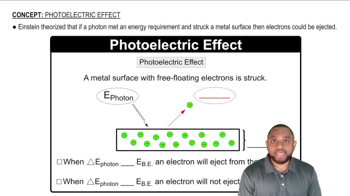
Photoelectric Effect

The photoelectric effect is a phenomenon where electrons are emitted from a material when it is exposed to light of sufficient energy. This effect is foundational for techniques like photoelectron spectroscopy (PES), as it demonstrates the interaction between light and matter, allowing for the measurement of the energy required to remove electrons from atoms.
추천 영상:
가이드 코스
02:31
Photoelectric Effect

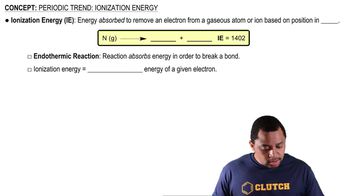
Ionization Energy

Ionization energy is the amount of energy required to remove an electron from an atom or ion in its gaseous state. It is a critical property of elements that influences their chemical behavior and reactivity. In the context of PES, ionization energy can be determined by analyzing the kinetic energy of emitted electrons when a sample is irradiated with light.
추천 영상:
가이드 코스
01:19
Ionization Energy

Ultraviolet Photoelectron Spectroscopy (PES)

Ultraviolet photoelectron spectroscopy (PES) is an analytical technique used to study the electronic structure of atoms and molecules. By directing monochromatic ultraviolet light onto a sample, PES measures the kinetic energy of emitted electrons, allowing researchers to calculate ionization energies and gain insights into the energy levels of electrons in different elements.
추천 영상:
가이드 코스
02:31
Photoelectric Effect
관련 실천
교과서 질문

Potassium superoxide, KO2, is often used in oxygen masks (such as those used by firefighters) because KO2 reacts with CO2 to release molecular oxygen. Experiments indicate that 2 mol of KO2(s) react with each mole of CO2(g). (c) What mass of KO2(s) is needed to consume 18.0 g CO2(g)? What mass of O2(g) is produced during this reaction?

1594
views
교과서 질문

One way to measure ionization energies is ultraviolet photoelectron spectroscopy (PES), a technique based on the photoelectric effect. (Section 6.2) In PES, monochromatic light is directed onto a sample, causing electrons to be emitted. The kinetic energy of the emitted electrons is measured. The difference between the energy of the photons and the kinetic energy of the electrons corresponds to the energy needed to remove the electrons (that is, the ionization energy). Suppose that a PES experiment is performed in which mercury vapor is irradiated with ultraviolet light of wavelength 58.4 nm. (c) The kinetic energy of the emitted electrons is measured to be 1.72 × 10⁻¹⁸ J. What is the first ionization energy of Hg, in kJ/mol?

561
views
교과서 질문

Moseley established the concept of atomic number by studying X rays emitted by the elements. The X rays emitted by some of the elements have the following wavelengths: Element Wavelength (pm) Ne 1461 Ca 335.8 Zn 143.5 Zr 78.6 Sn 49.1 (d) Use the result from part (b) to predict the X-ray wavelength emitted by iron.

552
views
교과서 질문

When magnesium metal is burned in air (Figure 3.5), two products are produced. One is magnesium oxide, MgO. The other is the product of the reaction of Mg with molecular nitrogen, magnesium nitride. When water is added to magnesium nitride, it reacts to form magnesium oxide and ammonia gas. d. Magnesium nitride can also be formed by reaction of the metal with ammonia at high temperature. Write a balanced equation for this reaction. If a 6.3-g Mg ribbon reacts with 2.57 g NH3(𝑔) and the reaction goes to completion, which component is the limiting reactant? What mass of H2(𝑔) is formed in the reaction?

2
views
교과서 질문

Moseley established the concept of atomic number by studying X rays emitted by the elements. The X rays emitted by some of the elements have the following wavelengths: Element Wavelength (pm) Ne 1461 Ca 335.8 Zn 143.5 Zr 78.6 Sn 49.1 (b) Plot the square root of n versus the atomic number of the element. What do you observe about the plot? (e) A particular element emits X rays with a wavelength of 98.0 pm. What element do you think it is?

427
views
교과서 질문

When magnesium metal is burned in air (Figure 3.5), two products are produced. One is magnesium oxide, MgO. The other is the product of the reaction of Mg with molecular nitrogen, magnesium nitride. When water is added to magnesium nitride, it reacts to form magnesium oxide and ammonia gas. c. In an experiment, a piece of magnesium ribbon is burned in air in a crucible. The mass of the mixture of MgO and magnesium nitride after burning is 0.470 g. Water is added to the crucible, further reaction occurs, and the crucible is heated to dryness until the final product is 0.486 g of MgO. What was the mass percentage of magnesium nitride in the mixture obtained after the initial burning?

2
views