
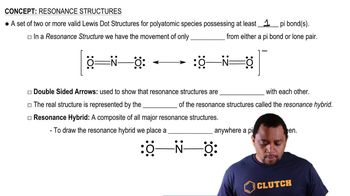
Ortho-Dichlorobenzene, C6H4Cl2, is obtained when two of the adjacent hydrogen atoms in benzene are replaced with Cl atoms. A skeleton of the molecule is shown here. (a) Complete a Lewis structure for the molecule using bonds and electron pairs as needed.

Ortho-Dichlorobenzene, C6H4Cl2, is obtained when two of the adjacent hydrogen atoms in benzene are replaced with Cl atoms. A skeleton of the molecule is shown here. (b) Are there any resonance structures for the molecule? If so, sketch them.
검증된 단계별 안내
비슷한 문제에 대한 검증된 영상 답변:
주요 개념
Resonance Structures
Delocalization of Electrons
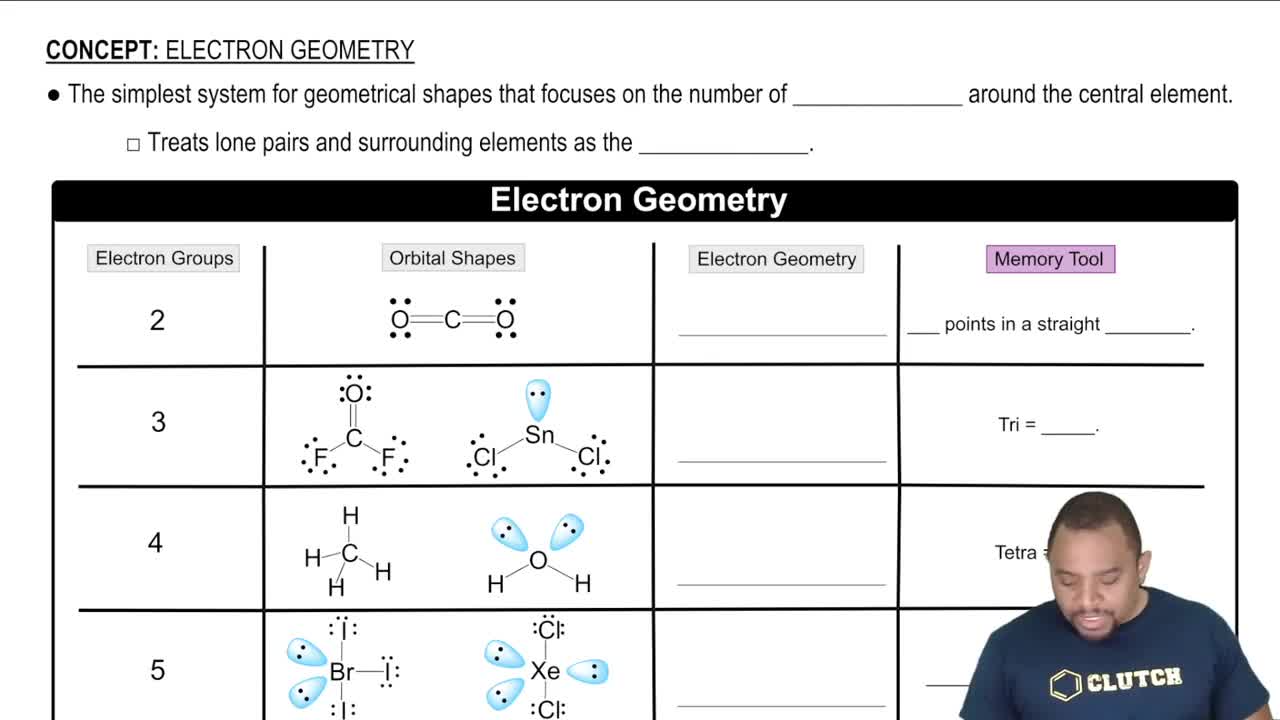
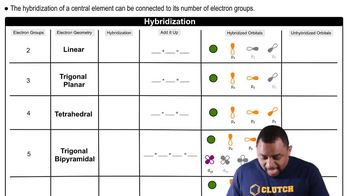
Molecular Geometry and Hybridization
Two compounds are isomers if they have the same chemical formula but different arrangements of atoms. Use Table 8.3 to estimate H for each of the following gas-phase isomerization reactions and indicate which isomer has the lower enthalpy. (d) Methyl isocyanide → Acetonitrile
The electron affinity of oxygen is -141 kJ/mol, corresponding to the reaction O(g) + e- → O-(g). The lattice energy of K2O(s) is 2238 kJ/mol. Use these data along with data in Appendix C and Figure 7.11 to calculate the 'second electron affinity' of oxygen, corresponding to the reaction O-(g) + e- → O2-(g)
a. Triazine, C3H3N3, is like benzene except that in triazine every other C—H group is replaced by a nitrogen atom. Draw the Lewis structure(s) for the triazine molecule.
