Ch.8 - Basic Concepts of Chemical Bonding
Brown - Chemistry: The Central Science 15th Edition
Brown15th EditionChemistry: The Central ScienceISBN: 9780137542970당신이 사용하는 게 아니라요?교과서 변경
8장, 문제 66

Draw the Lewis structures for each of the following molecules or ions. Identify instances where the octet rule is not obeyed; state which atom in each compound does not follow the octet rule; and state how many electrons surround these atoms: a. NO, b. BF3, c. ICl2, d. OPBr3 (the P is the central atom), e. XeF4.

검증된 단계별 안내
1
Draw the Lewis structure for NO: Start by counting the total number of valence electrons. Nitrogen has 5 valence electrons and oxygen has 6, totaling 11 electrons. Arrange the atoms with nitrogen and oxygen bonded together. Distribute the electrons to satisfy the octet rule as much as possible. Note that NO is a radical and does not fully obey the octet rule.
Draw the Lewis structure for BF_3: Boron has 3 valence electrons and each fluorine has 7, totaling 24 electrons. Arrange boron in the center with three fluorine atoms around it. Distribute the electrons to satisfy the octet rule for fluorine. Boron will have only 6 electrons, not obeying the octet rule.
Draw the Lewis structure for ICl_2^-: Iodine has 7 valence electrons, each chlorine has 7, and the extra negative charge adds 1 more electron, totaling 22 electrons. Place iodine in the center with two chlorine atoms and one lone pair around it. Distribute the electrons to satisfy the octet rule for chlorine. Iodine will have more than 8 electrons, exceeding the octet rule.
Draw the Lewis structure for OPBr_3: Oxygen has 6 valence electrons, phosphorus has 5, and each bromine has 7, totaling 40 electrons. Place phosphorus in the center with oxygen and three bromine atoms around it. Distribute the electrons to satisfy the octet rule for oxygen and bromine. Phosphorus will have more than 8 electrons, exceeding the octet rule.
Draw the Lewis structure for XeF_4: Xenon has 8 valence electrons and each fluorine has 7, totaling 36 electrons. Place xenon in the center with four fluorine atoms around it. Distribute the electrons to satisfy the octet rule for fluorine. Xenon will have more than 8 electrons, exceeding the octet rule.

비슷한 문제에 대한 검증된 영상 답변:

이 영상 해법은 위 문제에 도움이 된다고 튜터들이 추천한 것입니다.
영상 길이:
3m
도움이 되었나요?

주요 개념

질문에 올바르게 답하기 위해 반드시 이해해야 하는 핵심 개념들은 다음과 같습니다.

Lewis Structures

Lewis structures are diagrams that represent the bonding between atoms in a molecule and the lone pairs of electrons that may exist. They use dots to represent valence electrons and lines to indicate bonds between atoms. Understanding how to draw Lewis structures is essential for visualizing molecular geometry and predicting the behavior of molecules in chemical reactions.
추천 영상:
가이드 코스
04:28
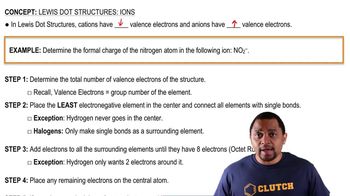
Lewis Dot Structures: Ions

Octet Rule

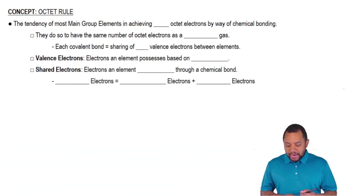
The octet rule is a chemical guideline stating that atoms tend to bond in such a way that they each have eight electrons in their valence shell, achieving a stable electron configuration similar to that of noble gases. While this rule applies to many main-group elements, there are exceptions, particularly for elements in the third period and beyond, which can accommodate more than eight electrons.
추천 영상:

Exceptions to the Octet Rule

Certain molecules and ions do not follow the octet rule, either because they have fewer than eight electrons (as in the case of some electron-deficient compounds) or because they can have expanded octets (as seen in elements like phosphorus and sulfur). Identifying these exceptions is crucial for accurately drawing Lewis structures and understanding the electronic structure of various compounds.
추천 영상: