

Energy is required to remove two electrons from Ca to form Ca2+, and energy is required to add two electrons to O to form O2 - . Yet CaO is stable relative to the free elements. Which statement is the best explanation? (a) The lattice energy of CaO is large enough to overcome these processes. (b) CaO is a covalent compound, and these processes are irrelevant. (c) CaO has a higher molar mass than either Ca or O. (d) The enthalpy of formation of CaO is small. (e) CaO is stable to atmospheric conditions.
Ch.8 - Basic Concepts of Chemical Bonding

8장, 문제 30
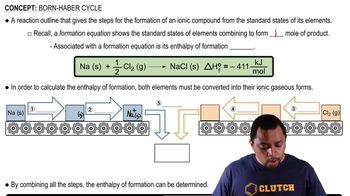
List the individual steps used in constructing a Born–Haber cycle for the formation of BaI2 from the elements. Which of the steps would you expect to be exothermic?
검증된 단계별 안내1

비슷한 문제에 대한 검증된 영상 답변:
이 영상 해법은 위 문제에 도움이 된다고 튜터들이 추천한 것입니다.
영상 길이:
5m도움이 되었나요?
주요 개념
질문에 올바르게 답하기 위해 반드시 이해해야 하는 핵심 개념들은 다음과 같습니다.
Born-Haber Cycle
The Born-Haber cycle is a thermodynamic cycle that relates the lattice energy of an ionic compound to the enthalpy changes involved in its formation from the constituent elements. It provides a systematic way to calculate the lattice energy by considering the various steps, including sublimation, ionization, and electron affinity, that occur when forming an ionic compound from its elements.
추천 영상:
가이드 코스
Born Haber Cycle
Lattice Energy
Lattice energy is the energy released when gaseous ions combine to form an ionic solid. It is a crucial factor in determining the stability of ionic compounds. In the context of the Born-Haber cycle, lattice energy is typically a large exothermic value, indicating that the formation of the ionic lattice from gaseous ions is energetically favorable.
추천 영상:
가이드 코스
Lattice Energy
Enthalpy Changes
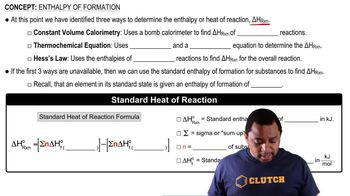
Enthalpy changes refer to the heat absorbed or released during a chemical reaction at constant pressure. In the Born-Haber cycle, various steps involve enthalpy changes, such as the enthalpy of sublimation, ionization energy, and electron affinity. Understanding which steps are exothermic (release heat) or endothermic (absorb heat) is essential for predicting the overall energy change in the formation of the compound.
추천 영상:
가이드 코스
Enthalpy of Formation
관련 실천
교과서 질문
1093
views
교과서 질문
Which of the following trends in lattice energy is due to differences in ionic radii: a. NaCl > RbBr > CsBr, b. BaO > KF, c. SrO > SrCl2?
1
views
교과서 질문
(a) Based on the lattice energies of MgCl2 and SrCl2 given in Table 8.1, what is the range of values that you would expect for the lattice energy of CaCl2?
1342
views
교과서 질문
Consider the ionic compounds KF, NaCl, NaBr, and LiCl. (a) Use ionic radii (Figure 7.8) to estimate the cation–anion distance for each compound.
1074
views
교과서 질문
Use data from Appendix C, Figure 7.11, and Figure 7.13 to calculate the lattice energy of KI.
2
views
교과서 질문
(b) Using data from Appendix C, Figure 7.11, Figure 7.13, and the value of the second ionization energy for Ca, 1145 kJ/mol, calculate the lattice energy of CaCl2.
699
views
