Ch.8 - Basic Concepts of Chemical Bonding
Brown - Chemistry: The Central Science 15th Edition
Brown15th EditionChemistry: The Central ScienceISBN: 9780137542970당신이 사용하는 게 아니라요?교과서 변경
8장, 문제 94b

The hypochlorite ion, ClO-, is the active ingredient in bleach. The perchlorate ion, ClO4-, is a main component of rocket propellants. Draw Lewis structures for both ions. (b) What is the formal charge of Cl in the perchlorate ion, assuming the Cl—O bonds are all single bonds?

검증된 단계별 안내
1
Step 1: For the hypochlorite ion (ClO^-), start by counting the total number of valence electrons. Chlorine has 7 valence electrons, oxygen has 6, and the negative charge adds 1 more electron, totaling 14 electrons.
Step 2: Draw the skeletal structure for ClO^-. Place Cl and O next to each other and connect them with a single bond. Distribute the remaining electrons to satisfy the octet rule, starting with the more electronegative atom, oxygen.
Step 3: For the perchlorate ion (ClO4^-), count the total number of valence electrons. Chlorine has 7 valence electrons, each oxygen has 6, and the negative charge adds 1 more electron, totaling 32 electrons.
Step 4: Draw the skeletal structure for ClO4^-. Place Cl in the center and connect it to four O atoms with single bonds. Distribute the remaining electrons to satisfy the octet rule for each oxygen atom.
Step 5: To find the formal charge of Cl in ClO4^-, use the formula: Formal Charge = (Valence electrons of Cl) - (Non-bonding electrons on Cl) - (Bonding electrons/2). Assume all Cl—O bonds are single bonds.

비슷한 문제에 대한 검증된 영상 답변:

이 영상 해법은 위 문제에 도움이 된다고 튜터들이 추천한 것입니다.
영상 길이:
2m

주요 개념

질문에 올바르게 답하기 위해 반드시 이해해야 하는 핵심 개념들은 다음과 같습니다.

Lewis Structures

Lewis structures are diagrams that represent the bonding between atoms in a molecule and the lone pairs of electrons that may exist. They help visualize the arrangement of electrons and the connectivity of atoms, which is crucial for understanding molecular geometry and reactivity. In the case of ions like ClO- and ClO4-, drawing the Lewis structure allows us to see how the chlorine and oxygen atoms are bonded and the distribution of electrons.
추천 영상:
가이드 코스
04:28
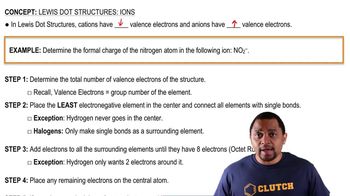
Lewis Dot Structures: Ions

Formal Charge

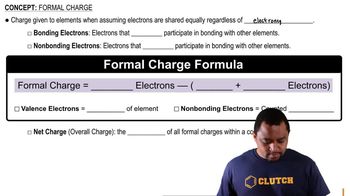
Formal charge is a concept used to determine the charge of an atom in a molecule or ion, calculated by comparing the number of valence electrons in the free atom to the number of electrons assigned to it in the Lewis structure. It helps assess the stability of a molecule and the distribution of charge. For the perchlorate ion, calculating the formal charge of chlorine involves considering its valence electrons and the bonds it forms with oxygen.
추천 영상:

Ionic and Covalent Bonds

Ionic and covalent bonds are two primary types of chemical bonds. Ionic bonds occur when electrons are transferred from one atom to another, resulting in charged ions, while covalent bonds involve the sharing of electrons between atoms. In the context of the hypochlorite and perchlorate ions, understanding these bonding types is essential for analyzing their structures and properties, particularly when considering the nature of the Cl—O bonds.
추천 영상:
가이드 코스
01:16
Chemical Bonds Example 1
관련 실천
교과서 질문

Mothballs are composed of naphthalene, C10H8, a molecule that consists of two six-membered rings of carbon fused along an edge, as shown in this incomplete Lewis structure:(a) Draw all of the resonance structures of naphthalene. How many are there?

762
views
교과서 질문

The following three Lewis structures can be drawn for N2O:

(b) The N—N bond length in N2O is 1.12 Å, slightly longer than a typical N≡N bond; and the N—O bond length is 1.19 Å, slightly shorter than a typical N═O bond (see Table 8.4). Based on these data, which resonance structure best represents N2O?

1698
views
교과서 질문

The triiodide ion, I3-, exists, whereas the corresponding ion with fluorine, F3-, does not. The I3- ion has a linear structure in which two outer I atoms are each bonded to a central I atom. Although I3- is a known ion, F3- is not.

c. Which of the following statements about the existence of I3- versus the nonexistence of F3- is or are true?

i. The Lewis structure of I3- shows 12 electrons around the central I atom.

ii. Elements from the second row of the periodic table generally do not form hypervalent molecules and ions.

iii. An I atom can form a hypervalent molecule or ion more readily than an F atom because of the larger size of the I atom.


2
views
교과서 질문

Structures A, B, and C show the connectivity of the atoms in three different molecules that are isomers of C3H4O. By completing the Lewis structures of these molecules, complete the information in the following table:

Isomer A Isomer B Isomer C

Number of single bonds

Number of double bonds

Number of triple bonds

Number of nonbonding pairs

교과서 질문

The following three Lewis structures can be drawn for N2O:

(a) Using formal charges, which of these three resonance forms is likely to be the most important?

1177
views
교과서 질문

A major challenge in implementing the 'hydrogen economy' is finding a safe, lightweight, and compact way of storing hydrogen for use as a fuel. The hydrides of light metals are attractive for hydrogen storage because they can store a high weight percentage of hydrogen in a small volume. For example, NaAlH4 can release 5.6% of its mass as H2 upon decomposing to NaH(s), Al(s), and H2(g). NaAlH4 possesses both covalent bonds, which hold polyatomic anions together, and ionic bonds. (d) What is the formal charge on hydrogen in the polyatomic ion?

338
views