Ch.8 - Basic Concepts of Chemical Bonding
Brown - Chemistry: The Central Science 15th Edition
Brown15th EditionChemistry: The Central ScienceISBN: 9780137542970당신이 사용하는 게 아니라요?교과서 변경
8장, 문제 39

Which of the following statements about electronegativity is or are true? i. The alkali metals are the family with the largest electronegativity values. ii. The numerical values for electronegativity have no units. iii. Electronegativity is the ability of an atom in a molecule to attract electron density toward itself.

검증된 단계별 안내
1
Step 1: Understand the concept of electronegativity. Electronegativity is a measure of the tendency of an atom to attract a bonding pair of electrons. It is a dimensionless quantity.
Step 2: Evaluate statement i. The alkali metals are located in Group 1 of the periodic table and are known for having low electronegativity values. Compare this with other groups, such as the halogens, which have higher electronegativity values.
Step 3: Evaluate statement ii. Electronegativity values are indeed dimensionless and have no units. They are typically expressed on the Pauling scale, which is a relative scale.
Step 4: Evaluate statement iii. This statement describes the concept of electronegativity accurately. It refers to the ability of an atom within a molecule to attract electron density towards itself.
Step 5: Determine which statements are true based on the evaluations: Statement ii and iii are true, while statement i is false.

비슷한 문제에 대한 검증된 영상 답변:

이 영상 해법은 위 문제에 도움이 된다고 튜터들이 추천한 것입니다.
영상 길이:
4m

주요 개념

질문에 올바르게 답하기 위해 반드시 이해해야 하는 핵심 개념들은 다음과 같습니다.

Electronegativity

Electronegativity is a measure of an atom's ability to attract and hold onto electrons within a chemical bond. It is a relative scale, often quantified using the Pauling scale, where higher values indicate a stronger attraction for electrons. This property influences molecular polarity and reactivity, making it essential for understanding chemical bonding.
추천 영상:
가이드 코스
02:10
Electronegativity Trends

Trends in Electronegativity

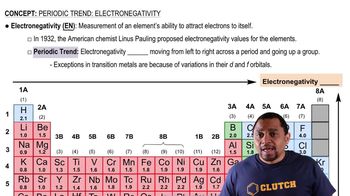
Electronegativity values vary across the periodic table, generally increasing from left to right across a period and decreasing from top to bottom within a group. Alkali metals, located in Group 1, have the lowest electronegativity values, while halogens, found in Group 17, exhibit the highest. Understanding these trends helps predict how different elements will interact in chemical reactions.
추천 영상:
가이드 코스
02:10
Electronegativity Trends

Units of Electronegativity

Electronegativity is a dimensionless quantity, meaning it does not have units. This characteristic allows for the comparison of electronegativity values across different elements without the need for conversion factors. The absence of units simplifies the understanding of how different atoms will behave in terms of electron attraction in various chemical contexts.
추천 영상:
가이드 코스
02:10
Electronegativity Trends