Ch.9 - Molecular Geometry and Bonding Theories
Brown - Chemistry: The Central Science 15th Edition
Brown15th EditionChemistry: The Central ScienceISBN: 9780137542970당신이 사용하는 게 아니라요?교과서 변경
9장, 문제 95a

a. Predict the electron-domain geometry around the central Xe atom in XeF2, XeF4, and XeF6.

검증된 단계별 안내
1
Step 1: Understand the concept of electron-domain geometry. Electron-domain geometry considers all regions of electron density (bonds and lone pairs) around the central atom.
Step 2: Determine the number of valence electrons for Xenon (Xe) and Fluorine (F). Xenon has 8 valence electrons, and each Fluorine has 7 valence electrons.
Step 3: Calculate the total number of valence electrons for each molecule. For XeF2, XeF4, and XeF6, add the valence electrons of Xe and the appropriate number of F atoms.
Step 4: Use the VSEPR (Valence Shell Electron Pair Repulsion) theory to predict the electron-domain geometry. Consider the number of bonding pairs and lone pairs around the central Xe atom.
Step 5: For XeF2, XeF4, and XeF6, identify the electron-domain geometry based on the number of electron domains: linear for 2 domains, square planar for 4 domains, and octahedral for 6 domains.

비슷한 문제에 대한 검증된 영상 답변:

이 영상 해법은 위 문제에 도움이 된다고 튜터들이 추천한 것입니다.
영상 길이:
4m
도움이 되었나요?

주요 개념

질문에 올바르게 답하기 위해 반드시 이해해야 하는 핵심 개념들은 다음과 같습니다.

VSEPR Theory

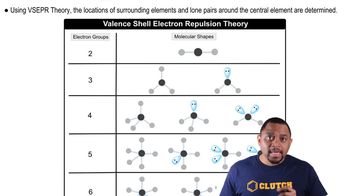
Valence Shell Electron Pair Repulsion (VSEPR) Theory is a model used to predict the geometry of molecules based on the repulsion between electron pairs surrounding a central atom. According to this theory, electron pairs, whether bonding or non-bonding, will arrange themselves to minimize repulsion, leading to specific molecular shapes.
추천 영상:
가이드 코스
02:13
Molecular Shapes and VSEPR

Electron-Domain Geometry

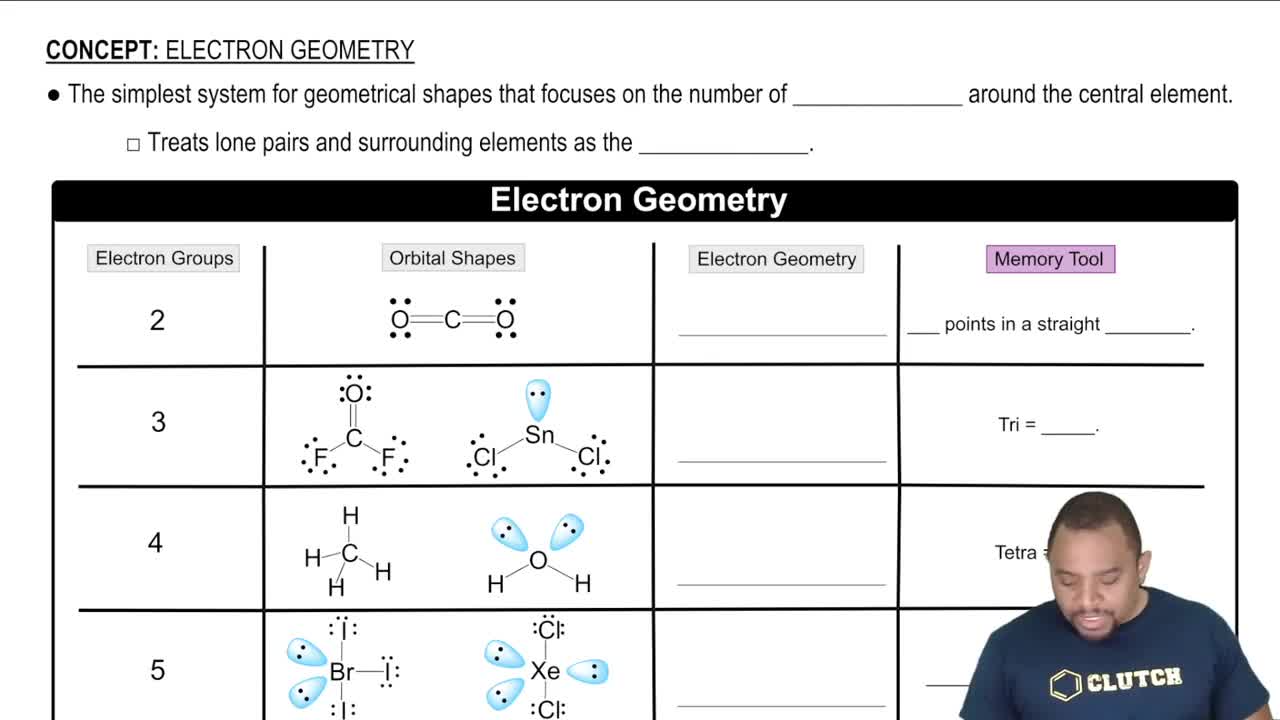
Electron-domain geometry refers to the spatial arrangement of all electron domains (bonding and lone pairs) around a central atom. This geometry helps in determining the overall shape of the molecule, which can differ from the molecular geometry if there are lone pairs present that affect the arrangement of bonded atoms.
추천 영상:
가이드 코스
04:44
Electron Geometry

Hybridization

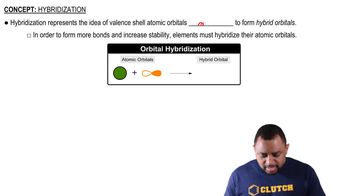
Hybridization is the concept of mixing atomic orbitals to form new hybrid orbitals that can accommodate the bonding pairs of electrons. In the case of xenon compounds like XeF2, XeF4, and XeF6, understanding the hybridization of the central xenon atom is crucial for predicting its electron-domain geometry and the resulting molecular shape.
추천 영상:
관련 실천
교과서 질문

An AB5 molecule adopts the geometry shown here.

c. Suppose the B atoms are halogen atoms. Of which group in the periodic table is atom A a member:

i. group 5A

ii. group 6A

iii. group 7A

iv. group 8A, or

v. is more information needed?

2
views

교과서 질문

The O—H bond lengths in the water molecule (H2O) are 0.96 Å, and the H—O—H angle is 104.5°. The overall dipole moment of the water molecule is 1.85 D. b. Calculate the magnitude of the bond dipole of the O─H bonds. (Note: You will need to use vector addition to do this.)

2
views
교과서 질문

Sodium azide is a shock-sensitive compound that releases N2 upon physical impact. The compound is used in automobile airbags. The azide ion is N3-. (a) Draw the Lewis structure of the azide ion that minimizes formal charge (it does not form a triangle). Is it linear or bent?

537
views
교과서 질문

The molecule C4H5N has the connectivity shown here. a. After the Lewis structure for the molecule is completed, how many 𝜎 and how many 𝜋 bonds are there in this molecule?

3
views
교과서 질문

Which of the following statements about hybrid orbitals is or are true? a. After an atom undergoes sp hybridization, there is one unhybridized p orbital on the atom, b. Under 𝑠𝑝2 hybridization, the large lobes point to the vertices of an equilateral triangle, and c. The angle between the large lobes of 𝑠𝑝3 hybrids is 109.5°.

교과서 질문

An AB5 molecule adopts the geometry shown here. b. What is the electron-domain geometry for the molecule?

3
views