
Ch.9 - Molecular Geometry and Bonding Theories
Brown - Chemistry: The Central Science 15th Edition
Brown15th EditionChemistry: The Central ScienceISBN: 9780137542970당신이 사용하는 게 아니라요?교과서 변경
9장, 문제 105

Place the following molecules and ions in order from smallest to largest bond order: H2+,B2,N2+,F2+, and Ne2.

검증된 단계별 안내
1
Identify the number of electrons in each molecule or ion. For molecular ions, adjust the electron count based on the charge. For example, H2+ has one less electron than H2.
Write the electron configuration for each molecule or ion using molecular orbital theory. Fill the molecular orbitals starting from the lowest energy level to the highest, following Hund's rule and the Pauli exclusion principle.
Count the number of electrons in bonding and antibonding orbitals. Bonding electrons contribute positively to bond order, while antibonding electrons subtract from it.
Calculate the bond order for each species using the formula: Bond Order = (Number of electrons in bonding orbitals - Number of electrons in antibonding orbitals) / 2.
Arrange the molecules and ions in order of increasing bond order based on the calculations from the previous step.

비슷한 문제에 대한 검증된 영상 답변:

이 영상 해법은 위 문제에 도움이 된다고 튜터들이 추천한 것입니다.
영상 길이:
13m

주요 개념

질문에 올바르게 답하기 위해 반드시 이해해야 하는 핵심 개념들은 다음과 같습니다.

Bond Order

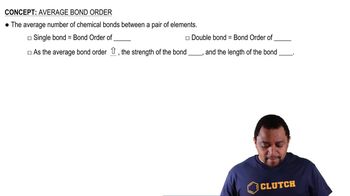
Bond order is a measure of the number of chemical bonds between a pair of atoms. It is calculated as the difference between the number of bonding and antibonding electrons divided by two. A higher bond order indicates a stronger bond and typically a shorter bond length. Understanding bond order is essential for comparing the stability and strength of different molecules and ions.
추천 영상:
가이드 코스
00:36
Average Bond Order

Molecular Orbital Theory

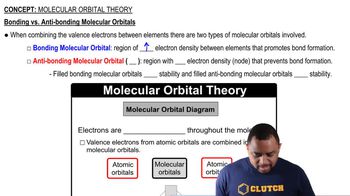
Molecular Orbital (MO) theory describes the behavior of electrons in molecules using molecular orbitals that can be occupied by electrons. Electrons in these orbitals can be bonding, antibonding, or non-bonding. This theory helps predict bond order by analyzing the filling of these orbitals, which is crucial for determining the relative bond orders of the given species.
추천 영상:
가이드 코스
03:06
Molecular Orbital Theory

Electron Configuration of Diatomic Molecules

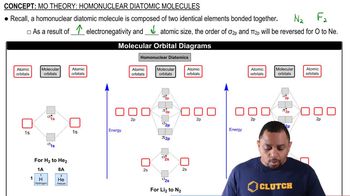
The electron configuration of diatomic molecules involves the arrangement of electrons in molecular orbitals. For the molecules in the question, understanding their electron configurations allows us to determine how many electrons occupy bonding and antibonding orbitals. This information is vital for calculating bond order and comparing the sizes of the bond orders among the specified molecules and ions.
추천 영상:
가이드 코스
03:10
Homonuclear Diatomic Molecules
관련 실천
교과서 질문

The highest occupied molecular orbital of a molecule is abbreviated as the HOMO. The lowest unoccupied molecular orbital in a molecule is called the LUMO. Experimentally, one can measure the difference in energy between the HOMO and LUMO by taking the electronic absorption (UV-visible) spectrum of the molecule. Peaks in the electronic absorption spectrum can be labeled as π2p2p*, σs2s*, and so on, corresponding to electrons being promoted from one orbital to another. The HOMO-LUMO transition corresponds to molecules going from their ground state to their first excited state. (c) The electronic absorption spectrum of the N2 molecule has the lowest energy peak at 170 nm. To what orbital transition does this correspond?

2896
views
교과서 질문

Azo dyes are organic dyes that are used for many applications, such as the coloring of fabrics. Many azo dyes are derivatives of the organic substance azobenzene, C12H10N2. A closely related substance is hydrazobenzene, C12H12N2. The Lewis structures of these two substances are

(Recall the shorthand notation used for benzene.) (b) How many unhybridized atomic orbitals are there on the N and the C atoms in each of the substances? How many unhybridized atomic orbitals are there on the N and the C atoms in hydrazobenzene?

674
views
교과서 질문

One of the molecular orbitals of the H2− ion can be sketched as follows:

a. Is the molecular orbital a 𝜎 or 𝜋 MO? Is it bonding or antibonding?

4
views
교과서 질문

One of the molecular orbitals of the H2− ion can be sketched as follows:

d. Compared to the H—H bond in H2, the H—H bond in H2− is expected to be which of the following?

i. shorter and stronger

ii. longer and stronger

iii. shorter and weaker

iv. longer and weaker or

v. the same length and strength

2
views
교과서 질문

Azo dyes are organic dyes that are used for many applications, such as the coloring of fabrics. Many azo dyes are derivatives of the organic substance azobenzene, C12H10N2. A closely related substance is hydrazobenzene, C12H12N2. The Lewis structures of these two substances are

(Recall the shorthand notation used for benzene.) (c) Predict the N¬N¬C angles in each of the substances.

513
views
교과서 질문

Carbon monoxide, CO, is isoelectronic to N2. (d) Would you expect the p2p MOs of CO to have equal atomic orbital contributions from the C and O atoms? If not, which atom would have the greater contribution?

1217
views