Ch.9 - Molecular Geometry and Bonding Theories
Brown - Chemistry: The Central Science 15th Edition
Brown15th EditionChemistry: The Central ScienceISBN: 9780137542970당신이 사용하는 게 아니라요?교과서 변경
9장, 문제 25a

Give the electron-domain and molecular geometries for the following molecules and ions: a. HCN

검증된 단계별 안내
1
Identify the central atom in the molecule. For HCN, the central atom is carbon (C).
Determine the number of electron domains around the central atom. In HCN, carbon is bonded to hydrogen (H) and nitrogen (N), and there are no lone pairs on carbon, resulting in two electron domains.
Use the VSEPR (Valence Shell Electron Pair Repulsion) theory to determine the electron-domain geometry. With two electron domains, the electron-domain geometry is linear.
Determine the molecular geometry. Since there are no lone pairs on the central atom and the electron-domain geometry is linear, the molecular geometry is also linear.
Summarize the geometries: For HCN, both the electron-domain geometry and the molecular geometry are linear.

비슷한 문제에 대한 검증된 영상 답변:

이 영상 해법은 위 문제에 도움이 된다고 튜터들이 추천한 것입니다.
영상 길이:
1m
도움이 되었나요?

주요 개념

질문에 올바르게 답하기 위해 반드시 이해해야 하는 핵심 개념들은 다음과 같습니다.

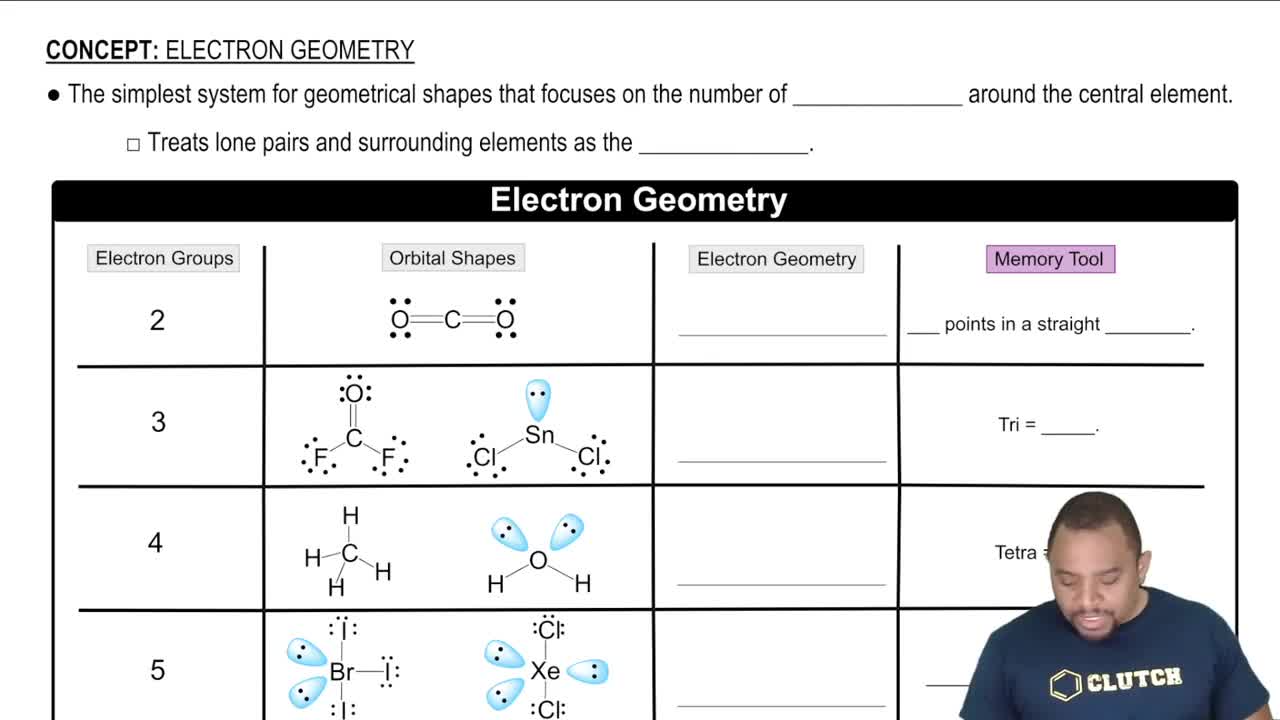
Electron-Domain Geometry

Electron-domain geometry refers to the spatial arrangement of all electron domains (bonding and lone pairs) around a central atom in a molecule. It is determined by the number of electron domains, which can include single bonds, double bonds, triple bonds, and lone pairs. The arrangement minimizes repulsion between these electron domains, leading to specific geometric shapes such as linear, trigonal planar, or tetrahedral.
추천 영상:
가이드 코스
04:44
Electron Geometry

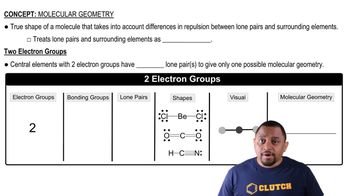
Molecular Geometry

Molecular geometry describes the three-dimensional arrangement of the atoms in a molecule, excluding lone pairs of electrons. It is influenced by the electron-domain geometry but focuses solely on the positions of the nuclei of the atoms. Common molecular geometries include linear, bent, trigonal planar, and tetrahedral, which can affect the molecule's physical and chemical properties.
추천 영상:
가이드 코스
01:33
Molecular Geometry with Two Electron Groups

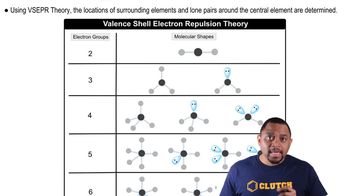
VSEPR Theory

Valence Shell Electron Pair Repulsion (VSEPR) theory is a model used to predict the geometry of individual molecules based on the repulsion between electron pairs in the valence shell of the central atom. According to VSEPR, electron pairs will arrange themselves as far apart as possible to minimize repulsion, which helps determine both the electron-domain and molecular geometries of a compound.
추천 영상:
가이드 코스
02:13
Molecular Shapes and VSEPR