
The iodine bromide molecule, IBr, is an interhalogen compound. Assume that the molecular orbitals of IBr are analogous to the homonuclear diatomic molecule F2. (c) One of the valence MOs of IBr is sketched here. Determine whether each of the following statements about this orbital is true: i. This is an antibonding orbital. ii. The larger contribution is from the I atom. iii. The energy of the molecular orbital is closer in energy to the valence atomic orbitals of Br than to those of I.
Ch.9 - Molecular Geometry and Bonding Theories

9장, 문제 89
Fill in the blank spaces in the following chart. If the molecule column is blank, find an example that fulfills the conditions of the rest of the row. Molecule Electron-Domain Hybridization Dipole Geometry of Central Atom Moment? Yes or No CO2 sp3 Yes sp3 No Trigonal planar No SF4 Octahedral No sp2 Yes Trigonal bipyramidal No XeF2
검증된 단계별 안내1
Identify the missing information in the first row of the table: the molecule and the geometry of the central atom.
The given electron-domain hybridization is \( \text{sp}^3 \), which typically corresponds to a tetrahedral geometry.
The dipole moment is 'Yes', indicating that the molecule is polar.
A common molecule with \( \text{sp}^3 \) hybridization and a polar nature is \( \text{CH}_3\text{Cl} \) (chloromethane).
Thus, the first row can be completed with the molecule \( \text{CH}_3\text{Cl} \) and the geometry of the central atom as tetrahedral.

비슷한 문제에 대한 검증된 영상 답변:
이 영상 해법은 위 문제에 도움이 된다고 튜터들이 추천한 것입니다.
영상 길이:
1m도움이 되었나요?
주요 개념
질문에 올바르게 답하기 위해 반드시 이해해야 하는 핵심 개념들은 다음과 같습니다.
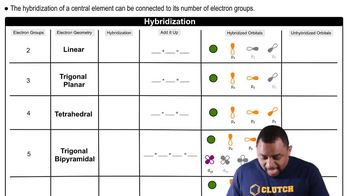
Electron-Domain Hybridization
Electron-domain hybridization is the process by which atomic orbitals mix to form new hybrid orbitals that can accommodate the electron pairs around a central atom. The type of hybridization (e.g., sp, sp2, sp3) depends on the number of electron domains, which include bonding pairs and lone pairs. Understanding this concept is crucial for predicting molecular geometry and the arrangement of atoms in a molecule.
추천 영상:
가이드 코스
Hybridization and Electron Geometry
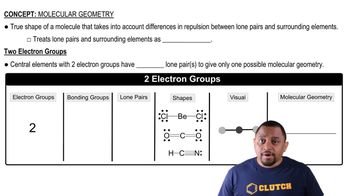
Molecular Geometry
Molecular geometry refers to the three-dimensional arrangement of atoms in a molecule, which is determined by the repulsion between electron pairs surrounding the central atom. The VSEPR (Valence Shell Electron Pair Repulsion) theory helps predict the geometry based on the number of bonding and lone pairs. This concept is essential for understanding the shape and polarity of molecules, which influences their chemical behavior.
추천 영상:
가이드 코스
Molecular Geometry with Two Electron Groups
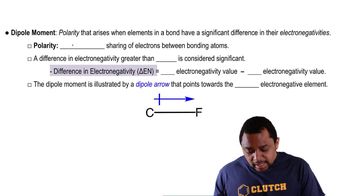
Dipole Moment
A dipole moment is a measure of the separation of positive and negative charges in a molecule, indicating its polarity. It arises when there is an uneven distribution of electron density, often due to differences in electronegativity between bonded atoms. Understanding dipole moments is important for predicting molecular interactions, solubility, and reactivity, as polar molecules behave differently than nonpolar ones.
추천 영상:
가이드 코스
Dipole Moment
관련 실천
교과서 질문
4
views
1
rank
교과서 질문
An AB3 molecule is described as having a trigonal-bipyramidal electron-domain geometry. a. How many nonbonding domains are on atom A?
2
views
교과서 질문
The lactic acid molecule, CH3CH(OH)COOH, gives sour milk its unpleasant, sour taste. e. What are the approximate bond angles around each carbon atom in the molecule?
2
views
교과서 질문
An AB3 molecule is described as having a trigonal-bipyramidal electron-domain geometry b. Based on the information given, which of the following is the molecular geometry of the molecule:
i. trigonal planar
ii. trigonal pyramidal
iii. T-shaped or
iv. tetrahedral?
3
views
교과서 질문
An AB5 molecule adopts the geometry shown here. b. What is the electron-domain geometry for the molecule?
3
views
