Consider the following XF4 ions: PF4-, BrF4-, ClF4+, and AlF4-. (a) Which of the ions have more than an octet of electrons around the central atom?
Ch.9 - Molecular Geometry and Bonding Theories

9장, 문제 32
In which of the following AFn molecules or ions is there more than one F-A-F bond angle: PF6⁻, SbF5, SF4?
검증된 단계별 안내1
Step 1: Identify the molecular geometry of each molecule or ion using VSEPR theory. This will help determine the bond angles present in each structure.
Step 2: For PF_6^-, note that phosphorus (P) is the central atom. It has 5 valence electrons, and with 6 fluorine (F) atoms, it forms an octahedral geometry, where all F-P-F bond angles are 90°.
Step 3: For SbF_5, antimony (Sb) is the central atom. It has 5 valence electrons, and with 5 fluorine atoms, it forms a trigonal bipyramidal geometry, which includes two different F-Sb-F bond angles: 90° and 120°.
Step 4: For SF_4, sulfur (S) is the central atom. It has 6 valence electrons, and with 4 fluorine atoms, it forms a seesaw geometry, which also includes two different F-S-F bond angles: less than 90° and less than 120°.
Step 5: Compare the geometries and bond angles of PF_6^-, SbF_5, and SF_4 to determine which have more than one F-A-F bond angle.
주요 개념
질문에 올바르게 답하기 위해 반드시 이해해야 하는 핵심 개념들은 다음과 같습니다.
Molecular Geometry
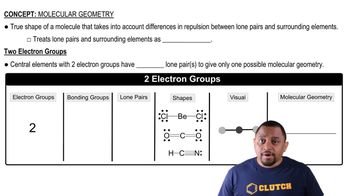
Molecular geometry refers to the three-dimensional arrangement of atoms within a molecule. It is determined by the number of bonding pairs and lone pairs of electrons around the central atom, which influences bond angles. Understanding molecular geometry is crucial for predicting the shape of molecules and the angles between bonds, which is essential for answering the question about F-A-F bond angles.
추천 영상:
가이드 코스
Molecular Geometry with Two Electron Groups
VSEPR Theory
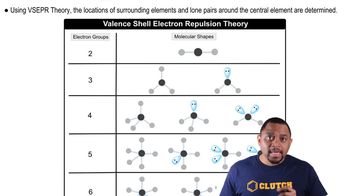
Valence Shell Electron Pair Repulsion (VSEPR) theory is a model used to predict the geometry of molecules based on the repulsion between electron pairs. According to VSEPR, electron pairs will arrange themselves to minimize repulsion, leading to specific molecular shapes and bond angles. This theory helps in determining whether a molecule has more than one bond angle by analyzing the arrangement of its electron pairs.
추천 영상:
가이드 코스
Molecular Shapes and VSEPR
Hybridization
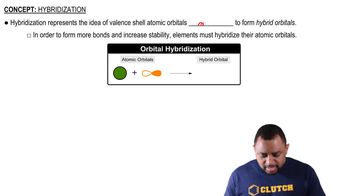
Hybridization is the concept of mixing atomic orbitals to form new hybrid orbitals that can accommodate bonding. The type of hybridization (e.g., sp, sp², sp³) affects the geometry and bond angles of a molecule. Understanding hybridization is important for analyzing the bonding in molecules like PF₆⁻, SbF₅, and SF₄, as it influences the presence of multiple bond angles in their structures.
추천 영상:
가이드 코스
Hybridization
관련 실천
교과서 질문
862
views
교과서 질문
Consider the following XF4 ions: PF4-, BrF4-, ClF4+, and AlF4-. (c) Which of the ions will have an octahedral electron-domain geometry?
1139
views
교과서 질문
Give the approximate values for the indicated bond angles in the following molecules: (d)
1408
views
교과서 질문
Ammonia, NH3, reacts with incredibly strong bases to produce the amide ion, NH2-. Ammonia can also react with acids to produce the ammonium ion, NH4+. (a) Which species (amide ion, ammonia, or ammonium ion) has the largest H¬N¬H bond angle? (b) Which species has the smallest H¬N¬H bond angle?
1045
views
교과서 질문
Give the approximate values for the indicated bond angles in the following molecules: (a)
427
views