
Sulfur tetrafluoride (SF4) reacts slowly with O2 to form sulfur tetrafluoride monoxide (OSF4) according to the following unbalanced reaction: SF4(g) + O2(g) → OSF4(g) The O atom and the four F atoms in OSF4 are bonded to a central S atom. (c) Use average bond enthalpies (Table 8.3) to estimate the enthalpy of the reaction. Is it endothermic or exothermic?
Ch.9 - Molecular Geometry and Bonding Theories

9장, 문제 113a
Methyl isocyanate, CH3NCO, was made infamous in 1984 when an accidental leakage of this compound from a storage tank in Bhopal, India, resulted in the deaths of about 3800 people and severe and lasting injury to many thousands more. (a) Draw a Lewis structure for methyl isocyanate.
검증된 단계별 안내1
Identify the total number of valence electrons in the molecule. Carbon (C) has 4, hydrogen (H) has 1, nitrogen (N) has 5, and oxygen (O) has 6. Calculate the total valence electrons for CH3NCO.
Determine the central atom. In this case, carbon (C) is often the central atom in organic molecules. Arrange the atoms in a reasonable structure: CH3 connected to NCO.
Draw single bonds between the central carbon and the surrounding atoms: C-H, C-N, and N-C-O. This uses up some of the valence electrons.
Distribute the remaining valence electrons to satisfy the octet rule for each atom, starting with the most electronegative atoms (O and N).
Adjust the structure to minimize formal charges, possibly by creating double or triple bonds, especially between C, N, and O, to ensure all atoms have a complete octet.

비슷한 문제에 대한 검증된 영상 답변:
이 영상 해법은 위 문제에 도움이 된다고 튜터들이 추천한 것입니다.
영상 길이:
2m주요 개념
질문에 올바르게 답하기 위해 반드시 이해해야 하는 핵심 개념들은 다음과 같습니다.
Lewis Structures
Lewis structures are diagrams that represent the bonding between atoms in a molecule and the lone pairs of electrons that may exist. They help visualize the arrangement of electrons and the connectivity of atoms, allowing chemists to predict molecular geometry and reactivity. In drawing a Lewis structure, one must account for the total number of valence electrons and ensure that each atom achieves a stable electron configuration, typically resembling that of noble gases.
추천 영상:
가이드 코스
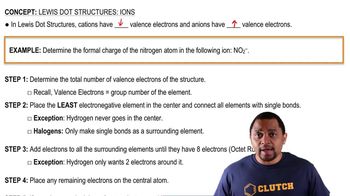
Lewis Dot Structures: Ions
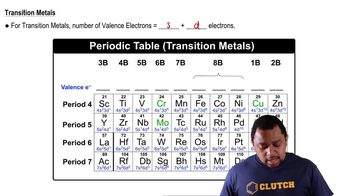
Valence Electrons
Valence electrons are the outermost electrons of an atom and are crucial in determining how an atom bonds with others. The number of valence electrons influences an atom's reactivity and the types of bonds it can form. For example, carbon has four valence electrons, allowing it to form four covalent bonds, while nitrogen has five, enabling it to form three bonds and hold a lone pair.
추천 영상:
가이드 코스
Transition Metals Valence Electrons
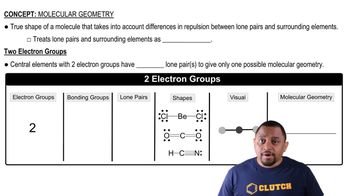
Molecular Geometry
Molecular geometry refers to the three-dimensional arrangement of atoms within a molecule. It is determined by the number of bonding pairs and lone pairs of electrons around the central atom, which affects the molecule's shape and properties. Understanding molecular geometry is essential for predicting the behavior of molecules in chemical reactions and their interactions with other substances.
추천 영상:
가이드 코스
Molecular Geometry with Two Electron Groups
관련 실천
교과서 질문
688
views
교과서 질문
Sulfur tetrafluoride (SF4) reacts slowly with O2 to form sulfur tetrafluoride monoxide (OSF4) according to the following unbalanced reaction: SF4(g) + O2(g) → OSF4(g) The O atom and the four F atoms in OSF4 are bonded to a central S atom. (b) Write a Lewis structure of OSF4 in which the formal charges of all atoms are zero.
400
views
교과서 질문
Sulfur tetrafluoride 1SF42 reacts slowly with O2 to form sulfur
tetrafluoride monoxide 1OSF42 according to the following
unbalanced reaction:
SF41g2 + O21g2¡OSF41g2
The O atom and the four F atoms in OSF4 are bonded to a
central S atom.
(e) For each of the molecules you drew in part (d), state how many
fluorines are equatorial and how many are axial.
102
views
