Ch.9 - Molecular Geometry and Bonding Theories
Brown - Chemistry: The Central Science 15th Edition
Brown15th EditionChemistry: The Central ScienceISBN: 9780137542970당신이 사용하는 게 아니라요?교과서 변경
9장, 문제 70

Which of the following statements about molecular orbitals and hybrid orbitals are true?
a. Molecular orbitals and hybrid orbitals are both created by mathematically mixing the wave functions of atomic orbitals.
b. Molecular orbitals are made by combining atomic orbitals from different atoms.
c. Hybrid orbitals and molecular orbitals are different names for the same things.
d. A hybrid orbital can hold more electrons than can a molecular orbital.

검증된 단계별 안내
1
Step 1: Understand the concept of molecular orbitals. Molecular orbitals are formed by the combination of atomic orbitals from different atoms, which can be bonding or antibonding.
Step 2: Understand the concept of hybrid orbitals. Hybrid orbitals are formed by the mixing of atomic orbitals from the same atom to form new orbitals that are degenerate and oriented in specific directions to form bonds.
Step 3: Evaluate statement a. Both molecular and hybrid orbitals involve the mathematical mixing of atomic orbitals, but they serve different purposes.
Step 4: Evaluate statement b. Molecular orbitals are indeed formed by combining atomic orbitals from different atoms, which is a true statement.
Step 5: Evaluate statements c and d. Hybrid orbitals and molecular orbitals are not the same, and a hybrid orbital does not hold more electrons than a molecular orbital.

비슷한 문제에 대한 검증된 영상 답변:

이 영상 해법은 위 문제에 도움이 된다고 튜터들이 추천한 것입니다.
영상 길이:
1m

주요 개념

질문에 올바르게 답하기 위해 반드시 이해해야 하는 핵심 개념들은 다음과 같습니다.

Molecular Orbitals

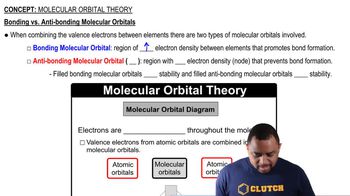
Molecular orbitals (MOs) are formed by the linear combination of atomic orbitals (LCAO) from different atoms in a molecule. They describe the probability distribution of electrons in a molecule and can be bonding, antibonding, or non-bonding. MOs allow for the understanding of molecular stability and reactivity, as they determine how electrons are shared or distributed between atoms.
추천 영상:
가이드 코스
03:06
Molecular Orbital Theory

Hybrid Orbitals

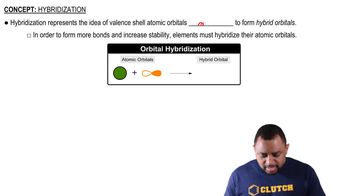
Hybrid orbitals are formed by the mixing of atomic orbitals from a single atom to create new orbitals that are degenerate in energy. This process allows for the formation of bonds with specific geometries, such as sp, sp2, or sp3 hybridization, which correspond to different molecular shapes. Hybrid orbitals are crucial for explaining the bonding in molecules with covalent bonds.
추천 영상:

Differences Between Molecular and Hybrid Orbitals

Molecular orbitals and hybrid orbitals serve different purposes in molecular chemistry. While molecular orbitals involve the combination of atomic orbitals from different atoms to describe electron distribution in a molecule, hybrid orbitals are concerned with the arrangement of atomic orbitals within a single atom to facilitate bonding. Understanding these distinctions is essential for analyzing molecular structure and bonding behavior.
추천 영상:
가이드 코스
03:06
Molecular Orbital Theory