Ch.1 - Chemical Tools: Experimentation & Measurement
McMurry - Chemistry 8th Edition
McMurry8th EditionChemistryISBN: 9781292336145당신이 사용하는 게 아니라요?교과서 변경
1장, 문제 101e

Concentrations of substances dissolved in solution are often expressed as mass per unit volume. For example, normal human blood has a cholesterol concentration of about 200 mg/100 mL. Express this concentration in the following units. (e) How much total blood cholesterol in grams does a per-son have if the normal blood volume in the body is 5 L?

검증된 단계별 안내
1
Convert the cholesterol concentration from mg/100 mL to g/L. Start by noting that 1 g = 1000 mg and 1 L = 1000 mL.
Use the conversion factor to convert 200 mg/100 mL to g/L. This involves multiplying by the appropriate factors to cancel out the units of mg and mL.
Calculate the total amount of cholesterol in grams for the entire blood volume. Use the concentration in g/L and multiply by the total blood volume in liters (5 L).
Set up the equation: Total cholesterol (g) = Concentration (g/L) * Blood volume (L).
Solve the equation to find the total cholesterol in grams.

비슷한 문제에 대한 검증된 영상 답변:

이 영상 해법은 위 문제에 도움이 된다고 튜터들이 추천한 것입니다.
영상 길이:
1m
도움이 되었나요?

주요 개념

질문에 올바르게 답하기 위해 반드시 이해해야 하는 핵심 개념들은 다음과 같습니다.

Concentration Units

Concentration is a measure of how much solute is present in a given volume of solvent or solution. Common units include mass per unit volume, such as mg/mL or g/L. Understanding how to convert between these units is essential for solving problems related to concentrations in solutions.
추천 영상:

Volume Conversion

In chemistry, it is often necessary to convert between different units of volume. For example, 1 liter (L) is equivalent to 1000 milliliters (mL). When calculating total amounts based on concentration, ensuring that the volume units match those of the concentration is crucial for accurate results.
추천 영상:
가이드 코스
02:38
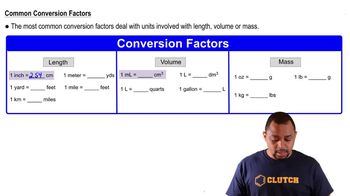
Common Conversion Factors

Mass Calculation

To find the total mass of a substance in a solution, you can use the formula: mass = concentration × volume. This relationship allows you to calculate the total mass of a solute when you know its concentration and the volume of the solution, which is key to answering questions about total amounts in a given volume.
추천 영상:
가이드 코스
03:12
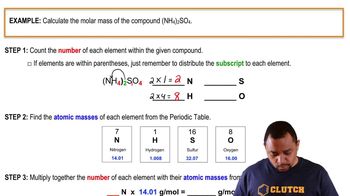
Molar Mass Calculation Example
관련 실천
교과서 질문
Weights in England are commonly measured in stones, where 1 stone = 14 lb. What is the weight in pounds of a person who weighs 8.65 stones?
4993
views

교과서 질문

Concentrations of substances dissolved in solution are often expressed as mass per unit volume. For example, normal human blood has a cholesterol concentration of about 200 mg/100 mL. Express this concentration in the following units. (a) mg/L

983
views
교과서 질문

Which is larger in each pair, and by approximately how much? (a) A liter or a quart

379
views
교과서 질문
Among many alternative units that might be considered as a measure of time is the shake rather than the second. Based on the expression 'faster than a shake of a lamb's tail,' we'll define 1 shake as equal to 2.5 * 10-4 s. If a car is traveling at 55 mi/h, what is its speed in cm/shake
563
views
교과서 질문

The height of a horse is usually measured in hands instead of in feet, where 1 hand equals 1/3 ft (exactly). (b) What is the volume in cubic meters of a box measuring 6 ⨉ 2.5 ⨉ 15 hands

1012
views
교과서 질문
Administration of digitalis, a drug used to control atrial fibrilla-tion in heart patients, must be carefully controlled because even a modest overdose can be fatal. To take differences between patients into account, drug dosages are prescribed in terms of mg/kg body weight. Thus, a child and an adult differ greatly in weight, but both receive the same dosage per kilogram of body weight. At a dosage of 20 mg/kg body weight, how many mil-ligrams of digitalis should a 160 lb patient receive?
856
views