Ch.1 - Chemical Tools: Experimentation & Measurement
McMurry - Chemistry 8th Edition
McMurry8th EditionChemistryISBN: 9781292336145당신이 사용하는 게 아니라요?교과서 변경
1장, 문제 48a

Express the following measurements in scientific notation. (a) 453.32 mg

검증된 단계별 안내
1
Identify the significant figures in the measurement: 453.32 mg.
Determine the position of the decimal point in the original number.
Move the decimal point to the right of the first non-zero digit to convert the number to a value between 1 and 10.
Count the number of places the decimal point was moved to determine the exponent of 10.
Express the number in scientific notation as \( a \times 10^n \), where \( a \) is the number obtained in step 3 and \( n \) is the exponent from step 4.

비슷한 문제에 대한 검증된 영상 답변:

이 영상 해법은 위 문제에 도움이 된다고 튜터들이 추천한 것입니다.
영상 길이:
56s

주요 개념

질문에 올바르게 답하기 위해 반드시 이해해야 하는 핵심 개념들은 다음과 같습니다.

Scientific Notation

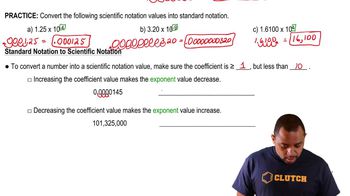
Scientific notation is a method of expressing numbers that are too large or too small in a compact form. It is written as the product of a number between 1 and 10 and a power of ten. For example, the number 453.32 can be expressed as 4.5332 x 10^2 in scientific notation.
추천 영상:
가이드 코스
02:50
Standard Notation to Scientific Notation

Significant Figures

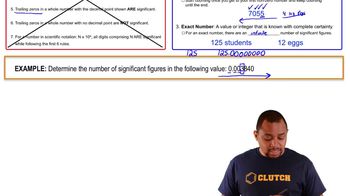
Significant figures are the digits in a number that contribute to its precision. This includes all non-zero digits, any zeros between significant digits, and trailing zeros in the decimal portion. When converting to scientific notation, it is important to maintain the correct number of significant figures to accurately represent the precision of the original measurement.
추천 영상:
가이드 코스
01:09
Significant Figures Example

Unit Conversion

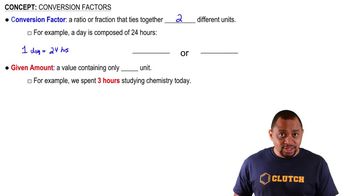
Unit conversion involves changing a measurement from one unit to another while maintaining its value. In this context, converting milligrams (mg) to grams (g) may be necessary, as 1 g equals 1000 mg. Understanding unit conversion is essential for correctly interpreting and expressing measurements in scientific notation.
추천 영상:
가이드 코스
01:56
Conversion Factors