Gaseous hydrogen has a density of 0.0899 g/L at 0 °C, and gaseous chlorine has a density of 3.214 g/L at the same tem-perature. How many liters of each would you need if you wanted 1.0078 g of hydrogen and 35.45 g of chlorine?
검증된 단계별 안내
1
Identify the given densities: hydrogen has a density of 0.0899 g/L and chlorine has a density of 3.214 g/L.
Determine the mass of hydrogen needed: 1.0078 g.
Determine the mass of chlorine needed: 35.45 g.
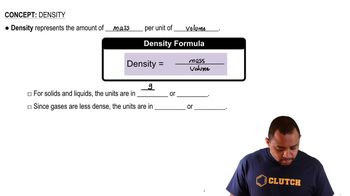
Use the formula for density, \( \text{Density} = \frac{\text{Mass}}{\text{Volume}} \), to find the volume of hydrogen needed: \( \text{Volume} = \frac{\text{Mass}}{\text{Density}} \).
Use the same formula to find the volume of chlorine needed: \( \text{Volume} = \frac{\text{Mass}}{\text{Density}} \).
비슷한 문제에 대한 검증된 영상 답변:
이 영상 해법은 위 문제에 도움이 된다고 튜터들이 추천한 것입니다.
영상 길이:
3m
영상 재생:
0 댓글
주요 개념
질문에 올바르게 답하기 위해 반드시 이해해야 하는 핵심 개념들은 다음과 같습니다.
Density
Density is defined as mass per unit volume, typically expressed in grams per liter (g/L) for gases. It is a crucial property that helps determine how much space a given mass of a substance will occupy. In this question, the densities of hydrogen and chlorine are provided, allowing us to calculate the volume needed to obtain specific masses of each gas.
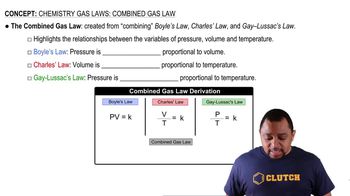
Gas laws describe the behavior of gases in relation to pressure, volume, and temperature. The ideal gas law (PV=nRT) is particularly relevant, as it relates the number of moles of a gas to its volume and density. Understanding these laws helps in calculating the volume of gases required for a given mass, especially under standard conditions.
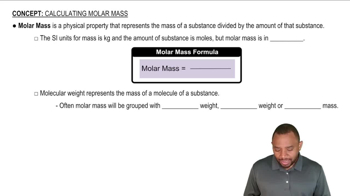
Molar mass is the mass of one mole of a substance, typically expressed in grams per mole (g/mol). It is essential for converting between mass and moles, which is necessary for applying the ideal gas law. In this question, knowing the molar masses of hydrogen (2.016 g/mol) and chlorine (70.906 g/mol) allows for accurate calculations of the volumes needed for the specified masses.


 검증된 단계별 안내
 01:56
01:56