Ch.1 - Chemical Tools: Experimentation & Measurement
McMurry - Chemistry 8th Edition
McMurry8th EditionChemistryISBN: 9781292336145당신이 사용하는 게 아니라요?교과서 변경
1장, 문제 110

Lignum vitae is a hard, durable, and extremely dense wood used to make ship bearings. A sphere of this wood with a diameter of 7.60 cm has a mass of 313 g. (a) What is the density of the lignum vitae sphere? (b) Will the sphere float or sink in water? (c) Will the sphere float or sink in chloroform? (The density of chloroform is 1.48 g/mL.)

검증된 단계별 안내
1
b>(a) Calculate the density of the lignum vitae sphere:
1. Use the formula for the volume of a sphere: \( V = \frac{4}{3} \pi r^3 \), where \( r \) is the radius of the sphere.
2. Convert the diameter to radius by dividing by 2: \( r = \frac{7.60 \text{ cm}}{2} \).
3. Substitute the radius into the volume formula to find the volume in cubic centimeters (cm³).
4. Use the density formula: \( \text{Density} = \frac{\text{mass}}{\text{volume}} \), where the mass is given as 313 g.
b>(b) Determine if the sphere will float or sink in water:
1. Recall that the density of water is approximately 1.00 g/mL (or 1.00 g/cm³).
2. Compare the density of the lignum vitae sphere to the density of water.
3. If the density of the sphere is greater than that of water, it will sink; if less, it will float.
b>(c) Determine if the sphere will float or sink in chloroform:
1. Use the given density of chloroform: 1.48 g/mL.
2. Compare the density of the lignum vitae sphere to the density of chloroform.
3. If the density of the sphere is greater than that of chloroform, it will sink; if less, it will float.

비슷한 문제에 대한 검증된 영상 답변:

이 영상 해법은 위 문제에 도움이 된다고 튜터들이 추천한 것입니다.
영상 길이:
3m
도움이 되었나요?

주요 개념

질문에 올바르게 답하기 위해 반드시 이해해야 하는 핵심 개념들은 다음과 같습니다.

Density

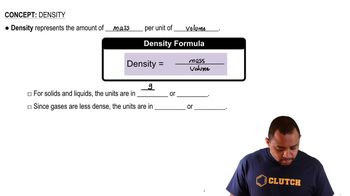
Density is defined as mass per unit volume, typically expressed in grams per cubic centimeter (g/cm³) or kilograms per cubic meter (kg/m³). It is a crucial property that helps determine whether an object will float or sink in a fluid. The formula for density is D = m/V, where D is density, m is mass, and V is volume. Understanding how to calculate density is essential for solving the problem regarding the lignum vitae sphere.
추천 영상:
가이드 코스
01:56
Density Concepts

Buoyancy

Buoyancy refers to the ability of an object to float in a fluid, which is determined by the relationship between the object's density and the density of the fluid. An object will float if its density is less than that of the fluid and sink if its density is greater. This principle is governed by Archimedes' principle, which states that the upward buoyant force on an object is equal to the weight of the fluid displaced by the object. Understanding buoyancy is key to answering whether the sphere will float or sink in water and chloroform.

Volume of a Sphere

The volume of a sphere can be calculated using the formula V = (4/3)πr³, where r is the radius of the sphere. This calculation is necessary to determine the volume of the lignum vitae sphere, which is essential for calculating its density. Knowing how to derive the volume from the diameter is important for solving part (a) of the question, as it directly impacts the density calculation.
추천 영상:
가이드 코스
02:35
Constant-Volume Calorimetry