Ch.1 - Chemical Tools: Experimentation & Measurement
McMurry - Chemistry 8th Edition
McMurry8th EditionChemistryISBN: 9781292336145당신이 사용하는 게 아니라요?교과서 변경
1장, 문제 62

What is the difference between a derived SI unit and a funda-mental SI unit? Give an example of each

검증된 단계별 안내
1
Understand that the International System of Units (SI) is a standardized system used globally for scientific measurements.
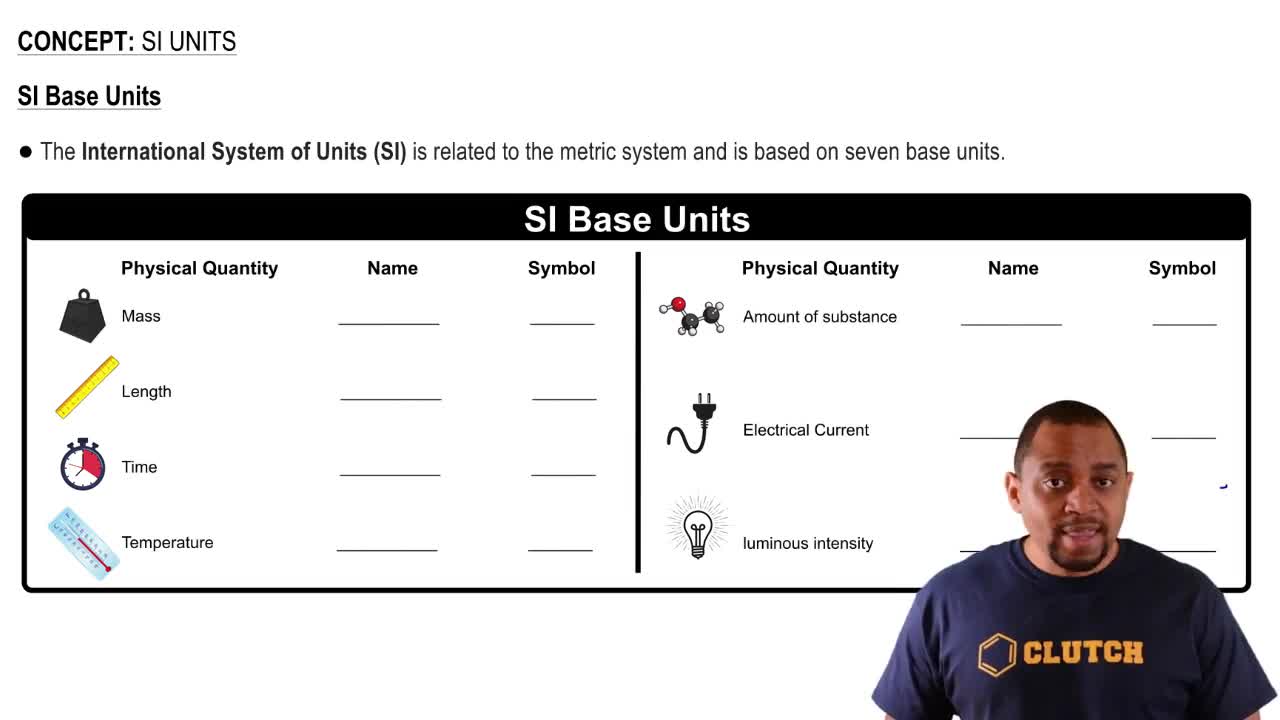
Recognize that fundamental SI units are the basic units from which all other units are derived. They are independent and cannot be broken down into simpler units. Examples include the meter (m) for length, the kilogram (kg) for mass, and the second (s) for time.
Identify that derived SI units are combinations of fundamental units. They are used to express quantities that are not directly measured by fundamental units. For example, the unit for force, the newton (N), is a derived unit expressed as kg·m/s².
Consider the process of deriving units: for instance, velocity is a derived unit expressed as meters per second (m/s), which combines the fundamental units of meters and seconds.
Reflect on the importance of both types of units in scientific measurements, where fundamental units provide the building blocks and derived units allow for the expression of more complex quantities.

비슷한 문제에 대한 검증된 영상 답변:

이 영상 해법은 위 문제에 도움이 된다고 튜터들이 추천한 것입니다.
영상 길이:
48s
도움이 되었나요?

주요 개념

질문에 올바르게 답하기 위해 반드시 이해해야 하는 핵심 개념들은 다음과 같습니다.

Fundamental SI Units

Fundamental SI units are the basic building blocks of the International System of Units (SI). They represent physical quantities that cannot be expressed in terms of other units. There are seven fundamental SI units, including the meter (length), kilogram (mass), and second (time), which serve as the foundation for all other measurements in science.
추천 영상:

Derived SI Units

Derived SI units are formed by combining fundamental SI units to measure more complex physical quantities. These units are created through mathematical relationships, such as multiplication or division. For example, the unit for velocity is meters per second (m/s), which combines the fundamental units of length (meters) and time (seconds).
추천 영상:

Examples of Units

An example of a fundamental SI unit is the kilogram, which measures mass. In contrast, an example of a derived SI unit is the newton (N), which measures force and is defined as one kilogram meter per second squared (kg·m/s²). Understanding these examples helps clarify the distinction between fundamental and derived units in scientific measurements.
추천 영상: