Ch.10 - Gases: Their Properties & Behavior
McMurry - Chemistry 8th Edition
McMurry8th EditionChemistryISBN: 9781292336145당신이 사용하는 게 아니라요?교과서 변경
10장, 문제 111

(a) The attractive forces between particles most affect the overall volume of the gas sample at _____ (high or low) pressure. (b) The attractive forces between particles cause the true volume of the gas sample to be ______ (larger or smaller) than the volume calculated by the ideal gas law.

검증된 단계별 안내
1
Step 1: Understand that the ideal gas law assumes no interactions between gas particles and that the volume of the gas particles themselves is negligible.
Step 2: Recognize that at high pressure, gas particles are forced closer together, increasing the effect of intermolecular forces.
Step 3: Consider how these attractive forces between particles can cause deviations from ideal behavior, particularly affecting the volume of the gas.
Step 4: Analyze how these attractive forces at high pressure can cause the gas to occupy less volume than predicted by the ideal gas law, as particles are pulled closer together.
Step 5: Conclude that the true volume of the gas is smaller than the volume calculated by the ideal gas law due to these attractive forces at high pressure.

주요 개념

질문에 올바르게 답하기 위해 반드시 이해해야 하는 핵심 개념들은 다음과 같습니다.

Gas Behavior and Pressure

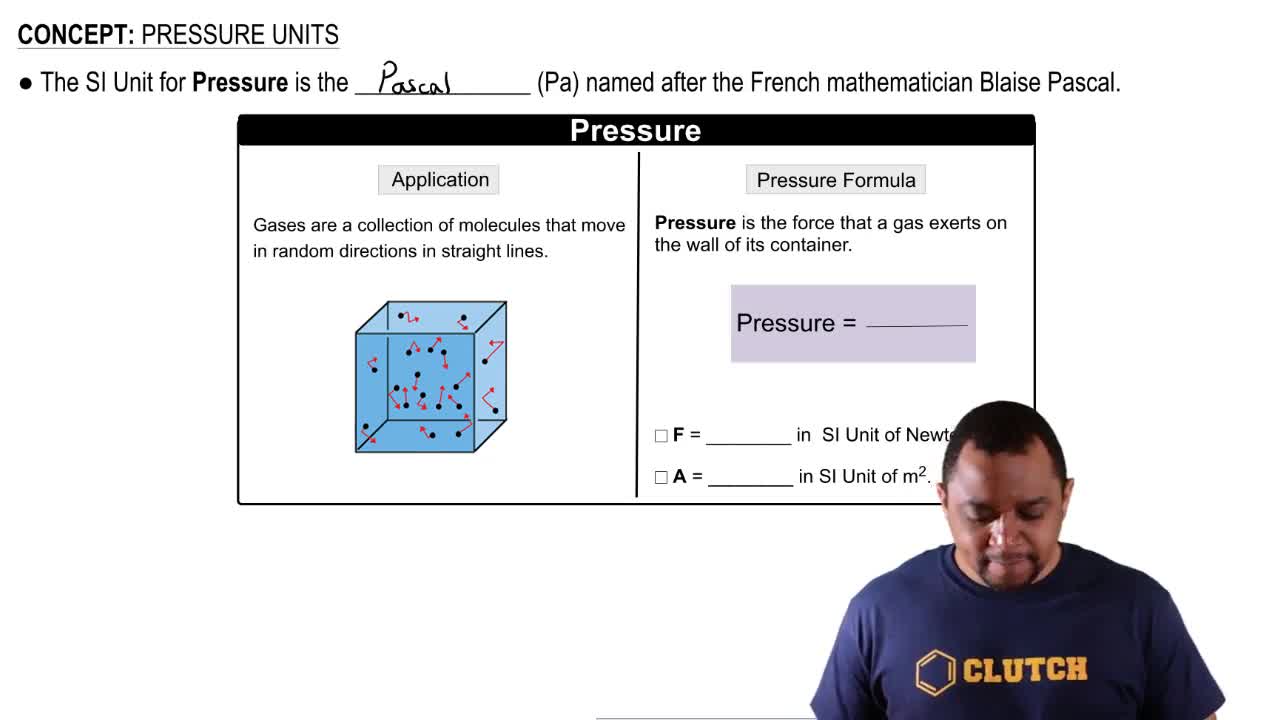
Gases behave differently under varying pressure conditions. At high pressure, gas particles are forced closer together, increasing the influence of intermolecular forces. This contrasts with low pressure, where particles are more spread out, and these forces have a minimal effect on the gas's volume.
추천 영상:

Intermolecular Forces

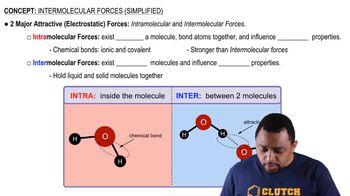
Intermolecular forces are the attractive forces between molecules that can affect the physical properties of substances. In gases, these forces are generally weak, but at high pressures, they become significant enough to alter the expected behavior of the gas, leading to deviations from ideal gas behavior.
추천 영상:
가이드 코스
01:59
Intermolecular vs Intramolecular Forces

Ideal Gas Law Limitations

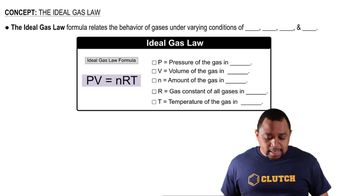
The ideal gas law (PV=nRT) assumes that gas particles do not interact and occupy no volume. However, real gases experience intermolecular attractions, especially at high pressures, causing the actual volume to be smaller than predicted by the ideal gas law. This highlights the limitations of the ideal gas law in accurately describing real gas behavior.
추천 영상:
가이드 코스
01:15
Ideal Gas Law Formula