Assume that you have a cylinder with a movable piston. What would happen to the gas pressure inside the cylinder if you were to do the following? (c) Decrease the volume by 45% at constant T
Ch.10 - Gases: Their Properties & Behavior
10장, 문제 49a
Assume that you have a cylinder with a movable piston. What would happen to the gas volume of the cylinder if you were to do the following? (a) Halve the Kelvin temperature while holding the pressure constant
검증된 단계별 안내1
Identify the initial conditions and the changes applied to the system. In this case, the initial condition is the gas in the cylinder at a certain temperature and pressure, and the change is halving the Kelvin temperature while keeping the pressure constant.
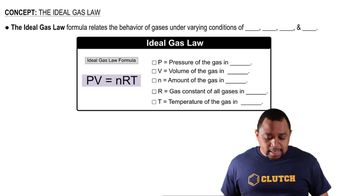
Recall the ideal gas law, which is expressed as PV = nRT, where P is the pressure, V is the volume, n is the number of moles of gas, R is the ideal gas constant, and T is the temperature in Kelvin.
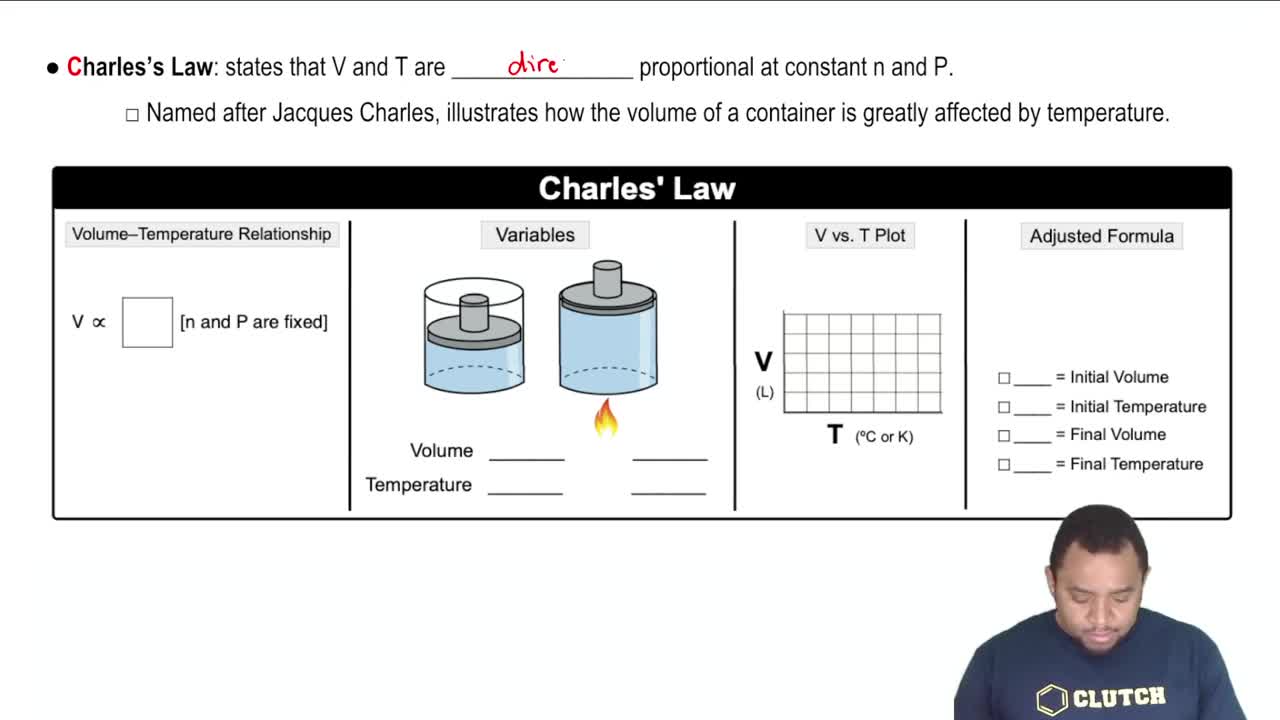
Understand that since the pressure (P) and the number of moles of gas (n) are held constant, and R is a constant, the relationship between volume (V) and temperature (T) can be simplified to V \(\propto\) T. This means that the volume is directly proportional to the temperature.
Apply the direct proportionality to predict the effect of the temperature change. If the temperature is halved (T becomes T/2), then the volume will also be halved (V becomes V/2) to maintain the equation V \(\propto\) T.
Conclude that when the Kelvin temperature of the gas is halved while keeping the pressure constant, the volume of the gas in the cylinder will also be halved.

비슷한 문제에 대한 검증된 영상 답변:
이 영상 해법은 위 문제에 도움이 된다고 튜터들이 추천한 것입니다.
영상 길이:
1m주요 개념
질문에 올바르게 답하기 위해 반드시 이해해야 하는 핵심 개념들은 다음과 같습니다.
Ideal Gas Law
The Ideal Gas Law relates the pressure, volume, temperature, and number of moles of a gas through the equation PV = nRT. This law is fundamental in understanding how gases behave under various conditions, allowing predictions about changes in volume when temperature or pressure is altered.
추천 영상:
가이드 코스
Ideal Gas Law Formula
Charles's Law
Charles's Law states that the volume of a gas is directly proportional to its absolute temperature (in Kelvin) when pressure is held constant. This means that if the temperature decreases, the volume will also decrease, which is crucial for analyzing the scenario of halving the temperature.
추천 영상:
가이드 코스
Charles's Law
Absolute Temperature
Absolute temperature is measured in Kelvin and is essential for gas law calculations. It starts at absolute zero, where molecular motion ceases. Understanding that temperature must be in Kelvin is vital when applying gas laws, as using Celsius or Fahrenheit would yield incorrect results.
추천 영상:
가이드 코스
Temperature vs Heat
관련 실천
교과서 질문
682
views
교과서 질문
Assume that you have a cylinder with a movable piston. What would happen to the gas volume of the cylinder if you were to do the following? (d) Double the Kelvin temperature and double the pressure
967
views
교과서 질문
Assume that you have a cylinder with a movable piston. What would happen to the gas pressure inside the cylinder if you were to do the following? (d) Halve the Kelvin temperature and triple the volume
467
views
교과서 질문
Which sample contains more molecules: 1.00 L of O2 at STP,
1.00 L of air at STP, or 1.00 L of H2 at STP?
983
views
교과서 질문
Assume that you have a cylinder with a movable piston. What would happen to the gas volume of the cylinder if you were to do the following? (b) Increase the amount of gas by one-fourth while holding the temperature and pressure constant
513
views