One mole of an ideal gas has a volume of 22.414 L at STP.
Assuming ideal behavior, what are the densities of the following
gases in g/L at STP?
(a) CH4 (b) CO2 (c) O2
검증된 단계별 안내
1
Identify the molar mass of each gas: (a) CH_4, (b) CO_2, (c) O_2.
Use the formula for density: \( \text{Density} = \frac{\text{Molar Mass}}{\text{Volume}} \).
Substitute the molar mass of each gas into the formula. Remember, the volume at STP is 22.414 L.
Calculate the density for each gas by dividing the molar mass by 22.414 L.
Express the density in g/L for each gas.
비슷한 문제에 대한 검증된 영상 답변:
이 영상 해법은 위 문제에 도움이 된다고 튜터들이 추천한 것입니다.
영상 길이:
1m
영상 재생:
0 댓글
주요 개념
질문에 올바르게 답하기 위해 반드시 이해해야 하는 핵심 개념들은 다음과 같습니다.
Ideal Gas Law
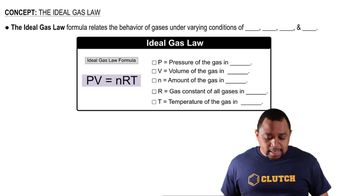
The Ideal Gas Law is a fundamental equation in chemistry that relates the pressure, volume, temperature, and number of moles of an ideal gas. It is expressed as PV = nRT, where P is pressure, V is volume, n is the number of moles, R is the ideal gas constant, and T is temperature in Kelvin. This law allows us to predict the behavior of gases under various conditions, particularly at standard temperature and pressure (STP).
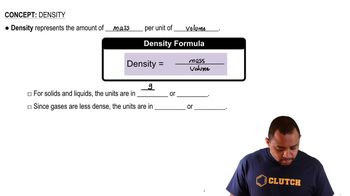
Density is defined as mass per unit volume. For gases, density can be calculated using the formula: density = mass/volume. At STP, one mole of an ideal gas occupies 22.414 L, which means the density of a gas can be determined by dividing its molar mass (in grams) by 22.414 L. This relationship is crucial for converting between mass and volume for gases.
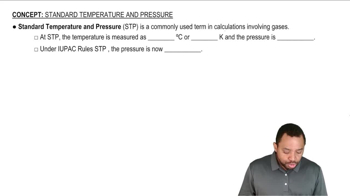
Standard Temperature and Pressure (STP) is a reference point used in chemistry to define the conditions under which gas measurements are made. STP is defined as a temperature of 0 degrees Celsius (273.15 K) and a pressure of 1 atmosphere (atm). Under these conditions, the behavior of ideal gases can be predicted accurately, and it serves as a standard for comparing gas properties.