
Ch.10 - Gases: Their Properties & Behavior
McMurry - Chemistry 8th Edition
McMurry8th EditionChemistryISBN: 9781292336145당신이 사용하는 게 아니라요?교과서 변경
10장, 문제 148

The Rankine temperature scale used in engineering is to the Fahrenheit scale as the Kelvin scale is to the Celsius scale. That is, 1 Rankine degree is the same size as 1 Fahrenheit degree, and 0 °R = absolute zero. (b) What is the value of the gas constant R on the Rankine scale in 1L ~ atm2>1°R ~ mol2? (c) Use the van der Waals equation to determine the pressure inside a 400.0-mL vessel that contains 2.50 mol of CH4 at a temperature of 525 °R. For CH4, a = 2.253 1L2 ~ atm2>mol2 and b = 0.04278 L>mol.

검증된 단계별 안내
1
(b) To find the value of the gas constant R on the Rankine scale, first recall the value of R in SI units (L atm / K mol). Convert the temperature from Kelvin to Rankine by using the conversion factor (1 K = 1.8 °R). Multiply the value of R by 1.8 to adjust for the scale change from Kelvin to Rankine.
(c) To use the van der Waals equation to determine the pressure inside the vessel, start by writing down the van der Waals equation: \( P = \frac{nRT}{V-nb} - \frac{an^2}{V^2} \), where P is the pressure, n is the number of moles, R is the gas constant, T is the temperature, V is the volume, a is the measure of attraction between particles, and b is the volume excluded by a mole of particles.
Substitute the given values into the van der Waals equation. Convert the volume of the vessel from mL to L (1 mL = 0.001 L).
Plug in the values for n (number of moles of CH4), R (gas constant in L atm / °R mol), T (temperature in °R), V (volume in L), a, and b into the van der Waals equation.
Simplify the equation to solve for P, the pressure inside the vessel.

비슷한 문제에 대한 검증된 영상 답변:

이 영상 해법은 위 문제에 도움이 된다고 튜터들이 추천한 것입니다.
영상 길이:
9m

주요 개념

질문에 올바르게 답하기 위해 반드시 이해해야 하는 핵심 개념들은 다음과 같습니다.

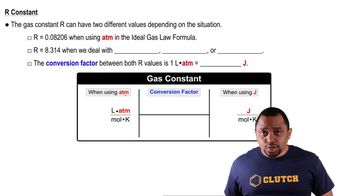
Gas Constant (R)

The gas constant (R) is a fundamental constant in the ideal gas law, representing the relationship between pressure, volume, temperature, and the number of moles of a gas. It has different values depending on the units used, such as 0.0821 L·atm/(K·mol) in the metric system. In the Rankine scale, R must be converted accordingly, as it is essential for calculations involving gas behavior under varying conditions.
추천 영상:
가이드 코스
01:56
Gas Constant Values

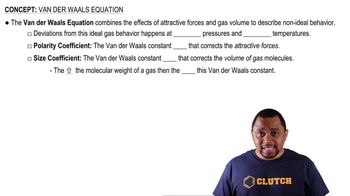
Van der Waals Equation

The van der Waals equation is an adjustment of the ideal gas law that accounts for the volume occupied by gas molecules and the attractive forces between them. It is expressed as (P + a(n/V)²)(V - nb) = nRT, where 'a' and 'b' are constants specific to each gas. This equation is particularly useful for real gases, providing a more accurate prediction of pressure, volume, and temperature relationships under non-ideal conditions.
추천 영상:
가이드 코스
01:40
Van der Waals Equation

Temperature Scales

Temperature scales, such as Rankine, Kelvin, Celsius, and Fahrenheit, provide a way to quantify thermal energy. The Rankine scale is an absolute temperature scale where 0 °R corresponds to absolute zero, similar to Kelvin. Understanding the relationships and conversions between these scales is crucial for solving thermodynamic problems, especially when applying equations like the van der Waals equation that require consistent temperature units.
추천 영상:
관련 실천
교과서 질문

Chemical explosions are characterized by the instantaneous release of large quantities of hot gases, which set up a shock wave of enormous pressure (up to 700,000 atm) and velocity (up to 20,000 mi/h). For example, explosion of nitroglycerin (C3H5N3O9) releases four gases, A, B, C, and D:

n C3H5N3O9(l) a A(g) + b B(g) + c C(g) + d D(g)

Assume that the explosion of 1 mol (227 g) of nitroglycerin releases gases with a temperature of 1950 °C and a volume of 1323 L at 1.00 atm pressure.

(e) Write a balanced equation for the explosion of nitroglycerin.

917
views
교과서 질문

Isooctane, C8H18, is the component of gasoline from which the term octane rating derives. (b) Assuming that gasoline is 100% isooctane, that isooctane burns to produce only CO2 and H2O, and that the density of isooctane is 0.792 g/mL, what mass of CO2 in kilograms is produced each year by the annual U.S. gasoline consumption of 4.6⨉1010 L?

1135
views
교과서 질문

Isooctane, C8H18, is the component of gasoline from which the term octane rating derives. (a) Write a balanced equation for the combustion of isooctane to yield CO2 and H2O.

518
views
교과서 질문

Chemical explosions are characterized by the instantaneous release of large quantities of hot gases, which set up a shock wave of enormous pressure (up to 700,000 atm) and velocity (up to 20,000 mi/h). For example, explosion of nitroglycerin (C3H5N3O9) releases four gases, A, B, C, and D:

n C3H5N3O9(l) a A(g) + b B(g) + c C(g) + d D(g)

Assume that the explosion of 1 mol (227 g) of nitroglycerin releases gases with a temperature of 1950 °C and a volume of 1323 L at 1.00 atm pressure.

(d) When gases C and D were passed through a hot tube of powdered copper, gas C reacted to form CuO. The remaining gas, D, was collected in a third 500.0-mL flask and found to have a mass of 0.168 g and a pressure of 223 mm Hg at 25 °C. How many moles each of C and D were present, and what are their likely identities?

603
views
교과서 질문

Isooctane, C8H18, is the component of gasoline from which the term octane rating derives. (d) How many moles of air are necessary for the combustion of 1 mol of isooctane, assuming that air is 21.0% O2 by volume? What is the volume in liters of this air at STP?

684
views