Ch.10 - Gases: Their Properties & Behavior
McMurry - Chemistry 8th Edition
McMurry8th EditionChemistryISBN: 9781292336145당신이 사용하는 게 아니라요?교과서 변경
10장, 문제 10.108c

Two 112-L tanks are filled with gas at 330 K. One contains 5.00 mol of Kr, and the other contains 5.00 mol of O2. Considering the assumptions of kinetic–molecular theory, rank the gases from low to high for each of the following properties.
(c) Average speed

검증된 단계별 안내
1
Step 1: The average speed of a gas molecule is given by the equation: \(v_{avg} = \sqrt{\frac{8kT}{\pi m}}\), where \(k\) is the Boltzmann constant, \(T\) is the temperature in Kelvin, and \(m\) is the molar mass of the gas.
Step 2: The molar mass of Kr is 83.798 g/mol and the molar mass of O2 is 32.00 g/mol. Convert these values to kg/mol by dividing by 1000, as the molar mass in the equation should be in kg/mol.
Step 3: Substitute the values of \(k\), \(T\), and \(m\) into the equation for each gas. Note that the temperature and the Boltzmann constant are the same for both gases, so the average speed is inversely proportional to the square root of the molar mass.
Step 4: Since O2 has a lower molar mass than Kr, it will have a higher average speed.
Step 5: Therefore, the gases ranked from low to high average speed are Kr and then O2.

비슷한 문제에 대한 검증된 영상 답변:

이 영상 해법은 위 문제에 도움이 된다고 튜터들이 추천한 것입니다.
영상 길이:
2m

주요 개념

질문에 올바르게 답하기 위해 반드시 이해해야 하는 핵심 개념들은 다음과 같습니다.

Kinetic Molecular Theory

Kinetic Molecular Theory explains the behavior of gases in terms of particles in constant motion. It posits that gas particles are far apart, move freely, and collide elastically. This theory helps in understanding how temperature and mass affect the speed of gas particles, which is crucial for comparing the average speeds of different gases.
추천 영상:
가이드 코스
01:19
Kinetic Molecular Theory

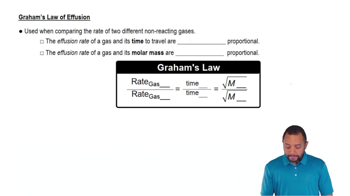
Graham's Law of Effusion

Graham's Law states that the rate of effusion of a gas is inversely proportional to the square root of its molar mass. This means lighter gases will effuse faster than heavier gases. This principle is essential for determining the average speed of gases, as it allows us to compare the speeds of Kr and O2 based on their molar masses.
추천 영상:
가이드 코스
2:03
Graham's Law of Effusion

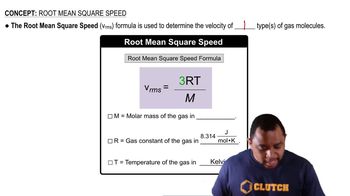
Root Mean Square Speed

The root mean square speed (rms speed) of a gas is a measure of the average speed of gas particles and is calculated using the formula v_rms = sqrt(3RT/M), where R is the gas constant, T is the temperature in Kelvin, and M is the molar mass. This concept is vital for ranking the average speeds of different gases, as it directly relates to their temperature and molar mass.
추천 영상:
가이드 코스
01:05
Root Mean Square Speed Formula
관련 실천
교과서 질문
An unknown gas is found to diffuse through a porous membrane 2.92 times more slowly than H2. What is the molecular weight of the gas? (a) 17.0 g/mol (b) 5.84 g/mol (c) 8.52 g/mol
803
views
교과서 질문
The coldest temperature recorded at ground level on Earth was -89.2 °C at the Vostok Station in Antarctica. What is the speed of a nitrogen molecule at this temperature? (LO 10.9) (a) 933 m/s (b) 40.2 m/s (c) 404 m/s (d) 12.8 m/s
740
views
교과서 질문
Identify the true statement about deviations from ideal gas behavior. (LO 10.12) (a) The attractive forces between gas particles cause the true volume of the sample to be larger than predicted by the ideal gas law. (b) The attractive forces between gas particles most influence the volume of a sample at low pressure. (c) The volume of the gas particles themselves most influences the volume of the sample at low pressure. (d) The volume of the gas particles themselves causes the true volume of the sample to be larger than predicted by the ideal gas law.
710
views
교과서 질문
A mixture of chlorine, hydrogen, and oxygen gas is in a container at STP. Which curve represents oxygen gas? (LO 10.8) (a) Curve (a) (b) Curve (b) (c) Curve (c)

491
views
교과서 질문
The apparatus shown consists of three bulbs connected by stopcocks. What is the pressure inside the system when the stopcocks are opened? Assume that the lines connecting the bulbs have zero volume and that the temperature remains constant. (LO 10.3, 10.7) (a) 1.10 atm (b) 1.73 atm (c) 4.14 atm (d) 1.41 atm

801
views
1
rank
교과서 질문

Two identical 732.0-L tanks each contain 212.0 g of gas at 293 K, with neon in one tank and nitrogen in the other. Based on the assumptions of kinetic–molecular theory, rank the gases from low to high for each of the following properties.

(a) Average speed

107
views