Ch.11 - Liquids & Phase Changes
McMurry - Chemistry 8th Edition
McMurry8th EditionChemistryISBN: 9781292336145당신이 사용하는 게 아니라요?교과서 변경
11장, 문제 18

A phase diagram for a substance that exhibits the liquid crystalline state is shown. (b) If the substance is at a temperature and pressure repre- sented by point 1 and the temperature is increased until the phase changes, what is the phase transition? Describe how the ordering of molecules changes, and propose a reason for the change.Phase diagram showing crystalline solid, smectic, nematic, and isotropic phases.

검증된 단계별 안내
1
Identify the initial phase of the substance at point 1 on the phase diagram.
Determine the direction of the temperature change (increase) and follow the path on the phase diagram.
Observe the phase boundary that is crossed first as the temperature increases.
Identify the new phase after crossing the boundary and describe the phase transition.
Explain the molecular ordering in the initial and final phases and propose a reason for the change in ordering.

비슷한 문제에 대한 검증된 영상 답변:

이 영상 해법은 위 문제에 도움이 된다고 튜터들이 추천한 것입니다.
영상 길이:
2m
도움이 되었나요?

주요 개념

질문에 올바르게 답하기 위해 반드시 이해해야 하는 핵심 개념들은 다음과 같습니다.

Phase Diagram

A phase diagram is a graphical representation that shows the phases of a substance as a function of temperature and pressure. It delineates the boundaries between different phases, such as solid, liquid, and gas, and indicates the conditions under which these phases exist. In the context of liquid crystals, the diagram also includes regions for smectic, nematic, and isotropic phases, which are crucial for understanding phase transitions.
추천 영상:
가이드 코스
03:22
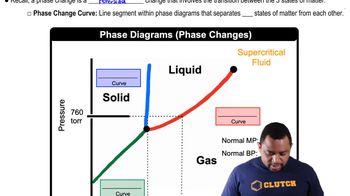
Phase Changes in Diagrams

Liquid Crystalline Phases

Liquid crystals are materials that exhibit properties between those of conventional liquids and solid crystals. The smectic and nematic phases are two types of liquid crystalline states. In the smectic phase, molecules are organized in layers, while in the nematic phase, they are aligned but not layered. Understanding these phases is essential for predicting how molecular ordering changes during phase transitions.
추천 영상:
가이드 코스
01:31
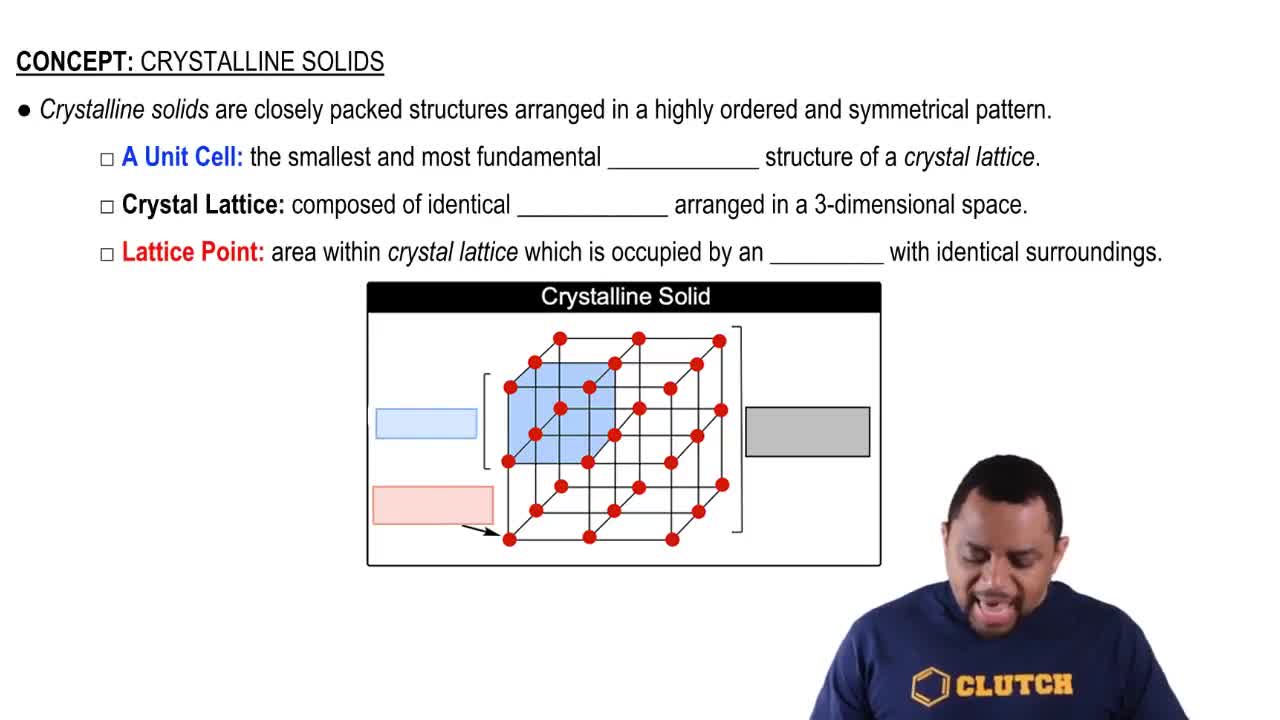
Crystalline Solids Structure

Phase Transition

A phase transition refers to the transformation of a substance from one phase to another, such as from solid to liquid or from liquid to gas. In the context of the question, as the temperature increases at a constant pressure, the substance may transition from a smectic or nematic phase to an isotropic phase. This transition involves a change in molecular ordering, where the structured arrangement of molecules in the smectic or nematic phase becomes more random in the isotropic phase.
추천 영상:
가이드 코스
03:22
Phase Changes in Diagrams