
Ch.11 - Liquids & Phase Changes
McMurry - Chemistry 8th Edition
McMurry8th EditionChemistryISBN: 9781292336145당신이 사용하는 게 아니라요?교과서 변경
11장, 문제 100

Draw a phase diagram showing how the phase boundaries differ for a pure solvent compared with a solution.Phase diagram comparing pure solvent and solution phases under varying pressure and temperature.
Phase diagram comparing pure solvent and solution phases under varying pressure and temperature.

검증된 단계별 안내
1
Identify the phase boundaries for the pure solvent and the solution on the phase diagram.
Note that the phase boundaries for the solution are shifted compared to the pure solvent.
Observe that the freezing point of the solution is lower than that of the pure solvent, indicating freezing point depression.
Observe that the boiling point of the solution is higher than that of the pure solvent, indicating boiling point elevation.
Draw the phase diagram with the phase boundaries for the pure solvent and the solution, clearly labeling the solid, liquid, and gas regions for both.

비슷한 문제에 대한 검증된 영상 답변:

이 영상 해법은 위 문제에 도움이 된다고 튜터들이 추천한 것입니다.
영상 길이:
2m
도움이 되었나요?

주요 개념

질문에 올바르게 답하기 위해 반드시 이해해야 하는 핵심 개념들은 다음과 같습니다.

Phase Diagram

A phase diagram is a graphical representation that shows the phases of a substance as a function of temperature and pressure. It illustrates the boundaries between different phases (solid, liquid, gas) and indicates the conditions under which each phase is stable. Understanding phase diagrams is crucial for analyzing how substances behave under varying environmental conditions.
추천 영상:
가이드 코스
03:22
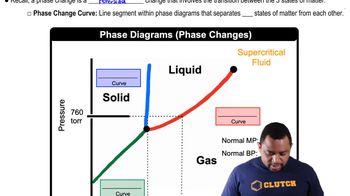
Phase Changes in Diagrams

Colligative Properties

Colligative properties are properties of solutions that depend on the number of solute particles in a given amount of solvent, rather than the identity of the solute. These properties include boiling point elevation, freezing point depression, vapor pressure lowering, and osmotic pressure. They play a significant role in understanding how the addition of solute affects the phase behavior of a solvent.
추천 영상:
가이드 코스
01:26
Colligative Properties

Phase Boundaries

Phase boundaries are the lines on a phase diagram that separate different phases of a substance. They indicate the conditions (temperature and pressure) at which two phases can coexist in equilibrium. In the context of pure solvents and solutions, the phase boundaries differ due to the presence of solute, which alters the physical properties and stability of the phases.
추천 영상:
가이드 코스
03:22
Phase Changes in Diagrams
관련 실천
교과서 질문
For each of the following substances, identify the intermolecular force or forces that predominate. Using your knowledge of the relative strengths of the various forces, rank the substances in order of their normal boiling points: Al2O3, F2, H2O, Br2, ICl, NaCl.
716
views
교과서 질문
Has the Earth's surface experienced warming as a result of increasing levels of greenhouse gases? If so, by how much?
331
views
교과서 질문
Propanol (PrOH) and methyl methacrylate (MMA) asso-ciate in solution by an intermolecular force, forming an adduct represented as PrOH•MMA. The equilibrium con- stant for the association reaction is Kc = 0.701 at 298 K. (b) Draw a plausible structure for the PrOH • MMA adduct. Use to signify an intermolecular interaction.
428
views
교과서 질문
1,3-Propanediol can form intramolecular as well as intermolecular hydrogen bonds. Draw a structure of 1,3-propanediol showing an intramolecular hydrogen bond.

547
views
교과서 질문
Just as individual bonds in a molecule are often polar, molecules as a whole are also often polar because of the net sum of individual bond polarities. There are three possible structures for substances with the formula C2H2Cl2, two of which are polar overall and one of which is not. (b) Which of the three structures is nonpolar, and which two are polar? Explain.
879
views
교과서 질문
Dimethyl ether has the following structure.

(b) Which of the following illustrations depicts the hydrogen bonding that occurs between dimethyl ether and water? (i)

(ii)

504
views